From Cairo’s bustling markets to Paris’s river quays, medieval cities concentrated money, ideas, and ambition. Yet our narratives often isolate "Islamic" and "Christian" worlds or reduce them to clash and crusade.
Cities as Mirrors: Why Compare Medieval Urban Worlds?
This comparative guide sets two broad urban traditions side by side: major cities of the Latin Christian West (e.g., Paris, Florence, London) and cities under Islamic rule (e.g., Cairo, Damascus, Córdoba). Using travel accounts, legal texts, market regulations, and archaeology, we explore how ordinary people lived, worked, and worshipped—and how these worlds overlapped and interacted.
1. City Plans: Grids, Labyrinths, and Sacred Anchors
Medieval Christian and Islamic cities rarely followed neat blueprints, but different planning logics emerge.
Christian Latin Cities
Many European towns grew atop Roman foundations. Archaeological surveys of cities like Cologne and York reveal:
- Reused Roman walls and street grids.
- New suburbs (faubourgs) spilling outside gates.
The cathedral or main church anchored the skyline. In Paris, the Île de la Cité, with Notre-Dame and royal palace, formed a dense power core. City charters and building ordinances show incremental, negotiated growth rather than centrally planned design.
Islamic Cities
Cities such as Cairo (founded 969), Damascus, and Fez reveal a different logic, discernible through archaeology and geographers like al-Muqaddasī (10th c.) and Ibn Battuta (14th c.). Common features include:
- A congregational mosque as central landmark.
- Suqs (markets) organized by craft and commodity, often in linear arrangements.
- Residential quarters by lineage, ethnicity, or profession.
Yet the stereotype of the "Islamic city" as purely labyrinthine and unplanned has been challenged. Excavations at places like Fustat and Samarra show episodes of deliberate planning, axial avenues, and palatial complexes.
In both traditions, religious monuments anchored urban identity. The difference lay more in administrative frameworks and legal ideas of space than in simple geometry.
2. Markets and Money: Suq vs. Piazza
Regulation and Authority
European city markets cluster around central squares: the piazza or marketplace near civic halls and churches. Town statutes from Siena or Lübeck regulate stall locations, weights, and curfews.
In contrast, Islamic cities developed elongated suqs, often covered, radiating from the central mosque. Mamluk-era waqf (endowment) documents from Cairo meticulously describe shops, shops’ rents, and endowed baths or khān (caravanserais).
Regulation reflected different institutions:
- In Christian towns, urban councils, bishops, and princes debated control through statutes and privileges.
- In Islamic cities, the muhtasib (market inspector) enforced moral and commercial norms, guided by manuals like Ibn al-Ukhuwwa’s Maʿālim al-Qurba (14th c.).
Yet both worlds worried about fraud, quality, and moral behavior in marketplaces. Sumptuary laws in Italian cities, for example, limited luxury dress just as hisba manuals condemned indecent behavior and dishonest trade.
Coinage and Credit
Archaeological coin hoards and mint records reveal differing monetary landscapes:
- The Islamic world maintained relatively stable gold (dinar) and silver (dirham) coinage across vast distances, facilitating long-distance trade.
- Western Europe, especially before the 13th century, endured more fragmented, debased coinages and relied heavily on local silver pennies.
Despite this, both systems innovated credit instruments. Italian merchants developed bills of exchange; Islamic traders employed suftaja (drafts) and qirad/mudaraba (profit-sharing partnerships). Documents from the Cairo Geniza (a trove of medieval Jewish records) show merchants in Fustat and beyond using sophisticated credit networks that linked Mediterranean and Indian Ocean ports.
3. Houses and Neighborhoods: Privacy, Gender, and Community
Domestic Architecture
Excavations and surviving houses paint different domestic ideals.
In European cities:
- Narrow, tall townhouses lined streets (e.g., in Rouen, Ghent).
- Ground floors were often shops or workshops; families lived above.
- Shared courtyards or rear yards provided limited open space.
In Islamic cities, especially in the Middle East and North Africa:
- Houses frequently turned inward around a courtyard.
- High walls and minimal street-facing windows preserved privacy.
- Separate sections (ḥarīm) could restrict male access to women’s quarters.
Travelers like the 12th-century Andalusi Ibn Jubayr, describing homes in Damascus and Mecca, marvel at lush interior courtyards, fountains, and careful seclusion.
Yet gendered separation was also present in Christian towns, if less architecturally codified. Household ordinances and moral treatises urge women to remain in the domestic sphere, even as tax records and guild documents attest to their active economic roles.
Neighborhood Solidarity
Both urban traditions organized space socially:
- European parishes fused religious and neighborhood identity. Parish records and confraternity statutes show mutual aid, processions, and local feasts.
- Islamic ḥāra or mahalla (quarters) could be defined by ethnicity (e.g., Jewish, Armenian), profession, or patronage. Waqf deeds and court records reveal networks of neighbors sharing wells, defending alleys, and litigating disputes.
Urban social control—through gossip, honor, and collective responsibility—worked similarly despite different religious frameworks.
4. Water, Waste, and Health: Managing the Invisible City
Water Systems
Islamic cities tended to invest heavily in water infrastructure, driven by ritual and practical needs. Archaeological studies in Damascus and Fez document:
- Aqueducts and channels feeding mosques, baths, and fountains.
- Cisterns beneath houses and courtyards.
Ritual ablutions before prayer and an emphasis on cleanliness reinforced demand for accessible water. Waqf endowments often funded public fountains and sabils.
European cities varied more. Some—like medieval London or Paris—developed conduit systems serving fountains and monastic houses, documented in city records and visible in surviving stone conduits. Others relied on wells and river access.
Waste and Sanitation
Both traditions struggled with waste. City ordinances from London, Barcelona, or Lübeck repeatedly ban dumping refuse in streets and rivers, demonstrating that people did so habitually.
Islamic legal literature addressed impurity and public health, but practice was uneven. Excavations in Fustat, for example, reveal dense rubbish layers, including animal bones, ceramics, and industrial waste.
Nevertheless, widespread use of baths in Islamic cities—supported by heating systems (hypocausts), documented fuel supplies, and bathhouse waqf endowments—likely affected hygiene and social life in ways distinct from the Christian West, where public baths declined or were morally suspect in many regions.
Modern urban anxieties about water quality, pollution, and disease echo these medieval struggles. Then, as now, infrastructure mirrored cultural values and political priorities.
5. Soundscapes and Sacred Rhythms: Bells and Calls to Prayer
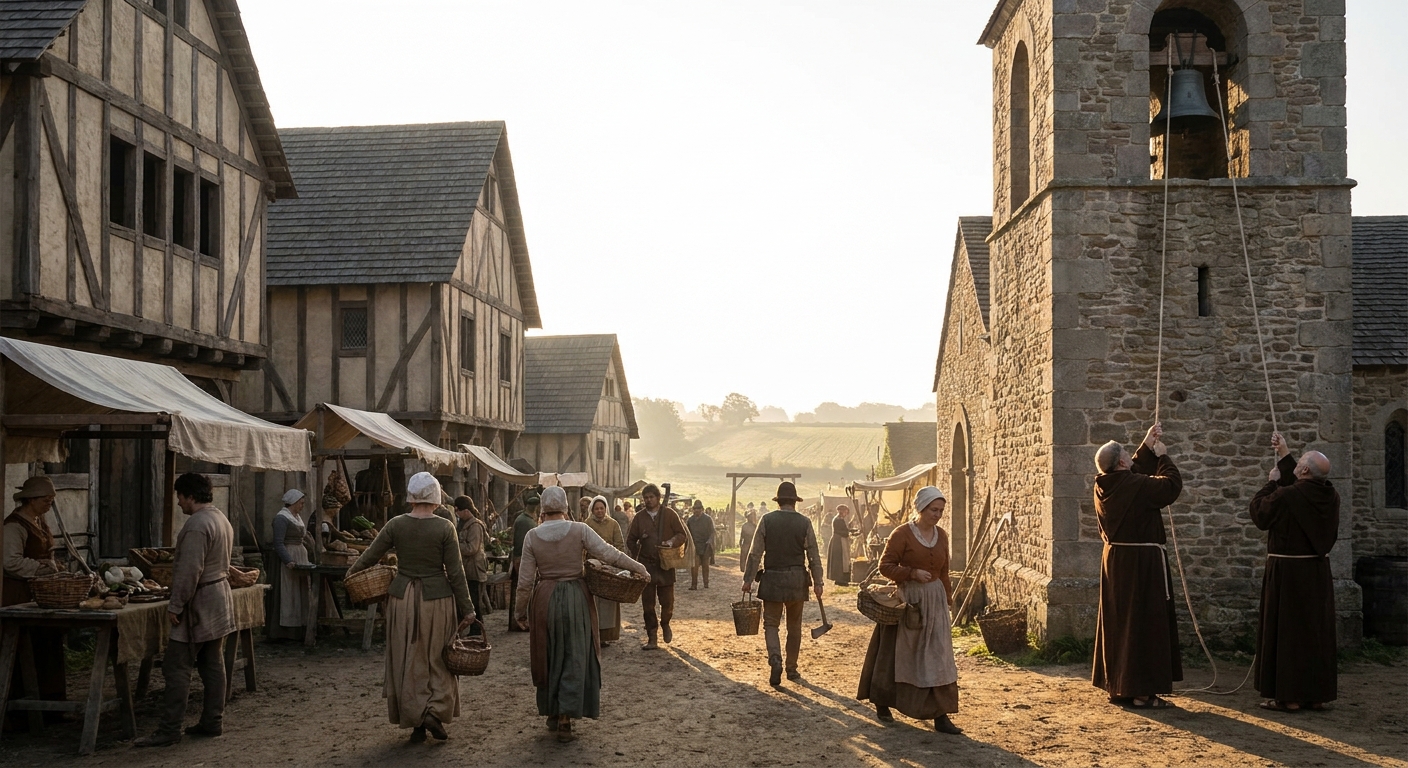
In Christian cities, bell towers—cathedral and parish—dominated the acoustic horizon. Bells signaled:
- Church services.
- Civic alarms (fires, attacks).
- Market openings and curfew.
Town statutes often specify bell times for closing taverns or shutting gates.
In Islamic cities, the muezzin’s call to prayer (adhan) from mosque minarets anchored daily rhythms. Travelers like Ibn Battuta describe the layered calls in Damascus and Cairo, one mosque echoing another.
Both soundscapes were religious and civic: sound organized time and space, marking belonging. To newcomers or religious minorities, these auditory regimes could be both comforting and coercive.
6. Minorities and Boundaries: Coexistence and Segregation
Christian West
Jews in European cities often lived in defined quarters (sometimes called "Jewish streets" or "Jewries"), as in medieval York or Frankfurt. Charters of protection and royal tax records detail their roles as moneylenders and traders.
Yet segregation intensified over time. The Fourth Lateran Council (1215) mandated distinctive dress for Jews, a directive gradually enforced in various realms. Pogroms and expulsions (England 1290, later Iberia) dramatically reshaped urban demographics.
Islamic Cities
Jews and Christians under Islamic rule (dhimmis) generally enjoyed legal recognition as "People of the Book" in exchange for taxes (jizya) and social restrictions.
Cairo Geniza documents show Jewish merchants deeply embedded in commercial life, trading with Muslims and Christians alike. Non-Muslim quarters existed in many cities, but segregation varied by time and place.
Travel accounts and legal texts also attest to periodic violence or discrimination; coexistence was pragmatic, not utopian. Yet the legal framework acknowledged permanent non-Muslim urban presence in ways less common in late medieval Western Europe.
Comparing these systems highlights different approaches to pluralism—both conditioned by theology but implemented through urban practice.
7. Knowledge and Culture: Schools, Libraries, and Performers
European cities hosted cathedral schools and, increasingly from the 12th century, universities (Paris, Bologna, Oxford). Manuscript evidence and stationers’ records show a growing book trade.
In Islamic cities, madrasas and private libraries flourished, particularly in places like Cairo and Damascus. Biographical dictionaries and endowment deeds mention endowed books, salaried teachers, and stipends for students.
Public performance was key in both:
- Trouvères and minstrels performed in European squares and halls.
- Storytellers and reciters of poetry animated suqs and coffeehouses (later) in Islamic cities.
Chronicles and travel narratives note these performers, though their own voices survive mainly indirectly.
Modern cultural quarters—bookshops, street musicians, lecture halls—descend from such urban ecologies of learning and entertainment.
8. Why This Comparison Matters Today
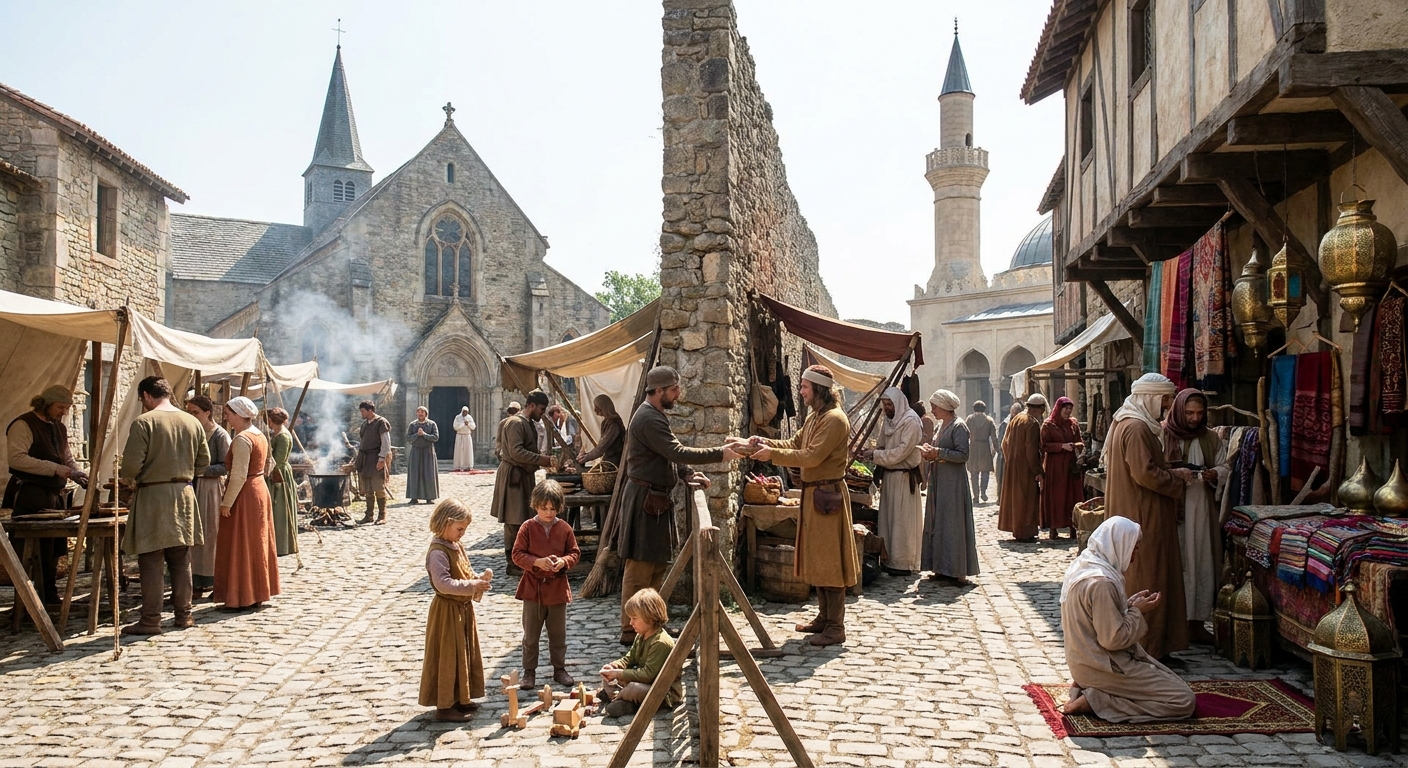
Juxtaposing medieval Christian and Islamic cities complicates simplistic "clash of civilizations" narratives. The historical record shows:
- Shared urban problems: sanitation, crowding, policing, fire.
- Parallel institutions: market inspectors and guilds, endowed charities and confraternities.
- Differing but dialoguing intellectual traditions, often linked by Mediterranean trade.
Material culture—from ceramics to glassware—often crossed boundaries. Islamic lustreware appears in European excavations; European cloth shows up in Middle Eastern records.
By studying how these cities organized work, belief, and belonging, we see that medieval urban life was neither monolithic nor static. Debates about religious pluralism, urban planning, and economic justice today gain depth when we recognize how earlier societies wrestled with similar questions under different theologies and technologies.
The medieval world, viewed through its cities, becomes less a distant "other" and more a set of laboratories whose experiments still shape the streets we walk.