Medieval Europe (c. 500–1500) is often framed as a bridge from Rome to the Renaissance. That metaphor misses something crucial: many structures we take for granted were forged or transformed in these centuries.
Why the Middle Ages Still Matter
This list-style explainer traces seven arenas—technology, law, health, finance, education, time, and identity—where medieval developments still frame modern life. Each point draws on primary sources, archaeological evidence, and current scholarship.
1. The Heavy Plow and the Idea of "Improvement"
Archaeological finds and pictorial sources (such as the 11th-century Bayeux Tapestry) reveal a key northern European innovation: the heavy, wheeled plow with an iron plowshare and mouldboard.
This tool:
- Cut deeper into heavy clay soils.
- Turned the earth fully, improving aeration and drainage.
- Worked best when pulled by teams of oxen (or later horses with improved harnesses).
Charters from regions like Carolingian Francia mention aratrum (plows) and team obligations; field systems reconstructed from aerial photography and landscape archaeology (e.g., "ridge and furrow" in England) show long, curved strips ideal for such plows.
This technology contributed to higher yields and supported demographic growth from the 10th–13th centuries. More food meant more people, more specialization, and more towns.
It also seeded a powerful modern idea: that land is something to be "improved" by technology and labor. Manorial records and agrarian treatises praise the clearing of forests and reclamation of wetlands—early precedents for modern discourses on agricultural optimization, with all their benefits and environmental costs.
2. Parliaments, Charters, and the Language of Rights
In 1215, a rebellious baronial coalition compelled King John of England to seal Magna Carta. Its clauses on due process and limits to royal power, recorded in chancery Latin, were initially very specific to English aristocratic politics.
Yet Magna Carta was copied, reissued, and cited in later legal struggles. A 1354 statute of Edward III famously declares:
> "No man, of whatever estate or condition, shall be put out of land or tenement… without being brought to answer by due process of law." (28 Edw. III c. 3)
Parliaments in England, Cortes in Iberia, and Estates in France were not democracies, but they established habits of representative consultation and documented consent. Parliamentary rolls show debates on taxation, petitions about grievances, and negotiations between crown and elites.
These practices influenced:
- Early modern constitutionalism in Britain and the Netherlands.
- Revolutionary rhetoric in America and France, which selectively appropriated Magna Carta as a proto-rights text.
Our language of "rights," "due process," and "representation" grew from this soil. Medieval people did not invent modern democracy, but they developed foundational tools and vocabularies for contesting power.
3. Universities and the Architecture of Knowledge
Universities emerged in the 12th and 13th centuries—Bologna for law, Paris for theology, Oxford and Cambridge soon after. Papal bulls (e.g., Parens scientiarum, 1231) and royal charters granted them corporate status and privileges.
Core medieval inventions still with us:
- Faculties: Theology, law, medicine, arts—ancestors of today’s disciplines.
- Degrees: Bachelor, master, doctor as formal stages.
- Curriculum: The trivium (grammar, rhetoric, logic) and quadrivium (arithmetic, geometry, music, astronomy) framed what it meant to be educated.
Manuscript lecture notes and commentaries on Aristotle show structured, text-based teaching. Disputations—formal debates on set questions—trained students in argument.
The university as a semi-autonomous corporation of masters and scholars, enjoying legal immunities and regulating admission, is a medieval creation. Modern debates around academic freedom, student status, and institutional autonomy have deep roots in conflicts recorded in university statutes and royal or papal interventions.
4. Banking, Bills, and the Birth of Global Finance
Medieval merchants pioneered techniques to move money without moving coins.
Italian City-States
In 13th-century Florence, Venice, and Genoa, merchant companies kept double-entry style records (fully systematized later) and used:
- Bills of exchange: Contracts allowing money to be paid in one currency and place, repaid in another.
- Partnerships: Like the commenda, where an investing partner and traveling partner shared profits.
Surviving ledgers (e.g., the Datini archive from Prato) show complex webs of credit extending from London to North Africa.
Islamic Trade Networks
Documents from the Cairo Geniza reveal Jewish and Muslim merchants using similar instruments (suftaja, qirad/mudaraba) to link the Mediterranean and Indian Ocean.
These developments normalized:
- Trust in abstract value over physical coin.
- The idea of risk-sharing and interest-like returns, even within religious constraints on usury.
Modern banks, letters of credit, and even digital transfers echo these medieval experiments. The infrastructure of global capitalism has medieval ancestors in port cities, counting-houses, and caravan routes.
5. Plague, Public Health, and Epidemiological Thinking
The Black Death (mid-14th century) devastated Eurasia and North Africa. Chronicles—like those of Giovanni Villani in Florence or Ibn al-Wardi in the Islamic world—describe mass mortality, social breakdown, and theological anxiety.
Archaeological mass graves in cities like London (East Smithfield) and Barcelona, with DNA evidence confirming Yersinia pestis, anchor these narratives biologically.
Medieval responses prefigure modern public health:
- Italian city-states implemented quarantine. Venice’s 14th-century records mention lazaretti (quarantine islands) and isolation of ships.
- Urban statutes restricted movement, gatherings, and sometimes burial practices.
- Physicians, drawing on Galenic theory, debated contagion, miasma, and environmental causes in texts like Guy de Chauliac’s Chirurgia Magna.
Though limited by pre-modern science, these measures show societies grappling with:
- Balancing commerce and health.
- Regulating bodies and spaces in crises.
- Recording mortality and patterns.
Our recent experiences with pandemics, lockdowns, and contested expertise resonate strongly with these medieval struggles.
6. Mechanical Clocks and the Discipline of Time
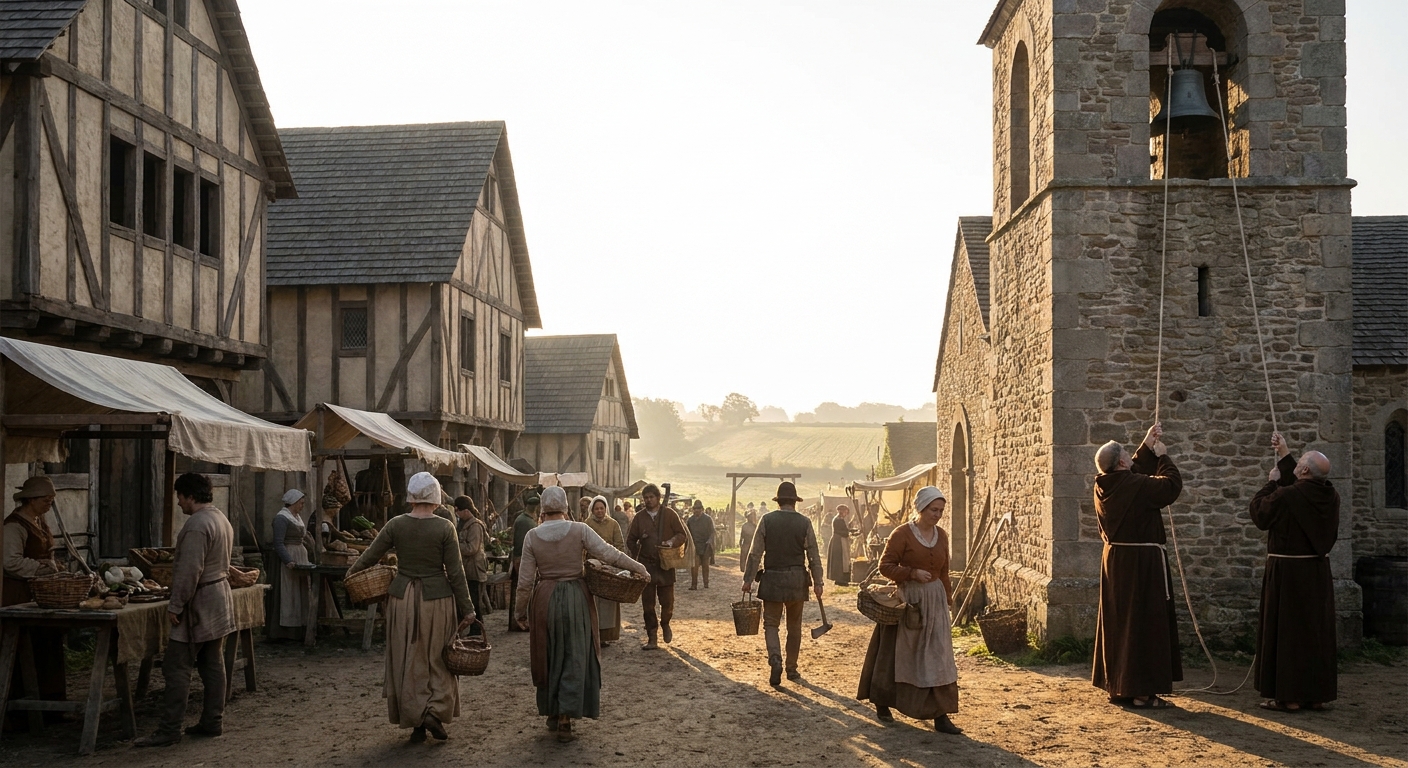
Time in early medieval Europe was ecclesiastical and local, marked by bells and natural cues. From the 13th century, mechanical weight-driven clocks appear in Italian and northern European cities.
A 14th-century chronicle from Milan notes the installation of a public clock as a civic achievement. Archaeological remains (gears, escapements) and surviving tower clocks show increasing precision.
Consequences:
- Standardization: Hours became more uniform, less tied to variable "canonical hours."
- Work discipline: Town statutes and guild rules began referencing clock time for opening and closing.
- Abstraction: Time as a measurable commodity detached from immediate natural cycles.
The shift from "it is time because the bell rings" to "the bell rings because it is time" altered how people thought about labor, prayer, and leisure. Our own anxieties about busyness, productivity, and "time management" emerge from this deeper history.
7. Nations, Myths, and the Politics of Memory
Medieval chronicles, epics, and legal texts helped craft stories about peoples that later hardened into nationalism.
Examples:
- The Chronicle of Nestor shaped narratives of "Rus" origins in Eastern Europe.
- Geoffrey of Monmouth’s History of the Kings of Britain (12th c.) invented a Trojan origin myth for the Britons, including King Arthur lore.
- French royal chroniclers at Saint-Denis linked Capetian kingship to sacred history.
These texts are full of legend, but they provided:
- Lineages connecting ruling dynasties to heroic or biblical pasts.
- Maps of "us" and "them" (Franks vs. "Saracens," Christians vs. pagans, etc.).
Law codes and vernacular literature reinforced linguistic and cultural boundaries. Over centuries, these medieval stories were revived and weaponized by modern nationalists.
Recognizing their medieval roots helps demystify modern identity politics. The narratives feel ancient because many of them are; they also remain edited, selective, and contestable—just as medieval chroniclers tailored the past for their patrons.
Seeing the Medieval in the Modern
From the tractors in our fields to the constitutions in our courts, from university lecture halls to bank apps and public-health dashboards, the medieval world lingers in structures and assumptions we rarely question.
Primary sources—charters, chronicles, legal codes—combined with archaeological evidence—plows, coins, bones, clockworks—let us see how people centuries ago improvised responses to problems we still face: feeding populations, limiting rulers, educating youth, handling disease, measuring time, and telling collective stories.
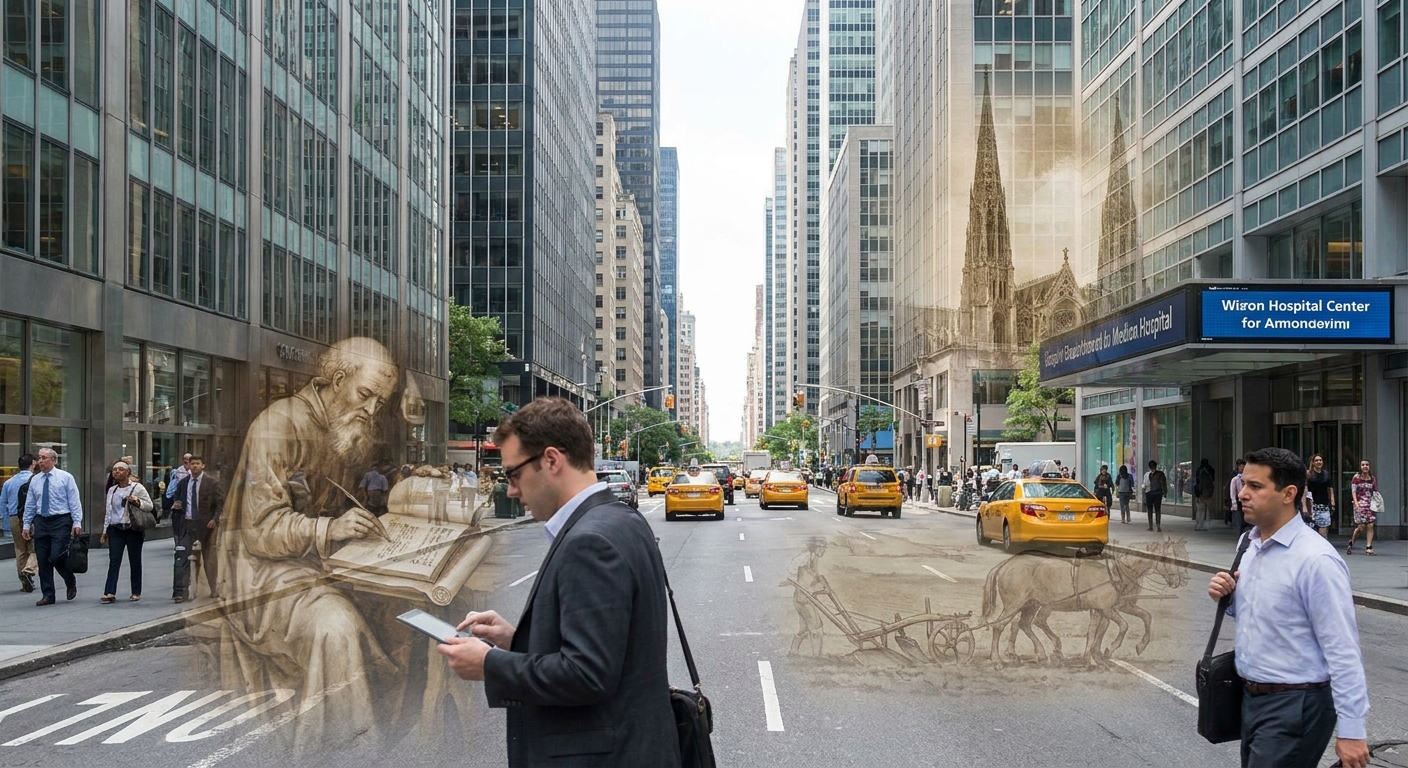
Studying these medieval experiments does not mean idealizing them. It means recognizing that our world is not a clean break from a "dark age" but a palimpsest. Beneath the touchscreen lies parchment; under the asphalt, the plow.