The sunlight over Pompeii did not rise into marble forums and senatorial debates. For most Romans, it slipped between wooden shutters, across cramped rooms, and over half‑forgotten tools. To reconstruct a single day in an ordinary Roman’s life, historians turn not to imperial biographies but to broken pots, carbonized bread, graffiti, and tax records.
Waking Up in Insula III
One particularly rich case study is Insula I.9 in Pompeii, a city entombed by Vesuvius in 79 CE. Excavations here, and in comparable insulae (apartment blocks) in Ostia and Rome, reveal a dense world of work, noise, smells, and negotiation.
The typical inhabitant of this insula was not an aristocrat but an artisan, shopkeeper, enslaved worker, or tenant. They lived above and behind workshops, in rooms measured more often in cubits than in comfort.
Morning: Bread, Noise, and Negotiation
The Soundscape of a Roman Morning
Roman mornings began early. By dawn, the streets were already loud enough that the satirist Juvenal complained of city noise keeping him from sleep (Satires 3.232–238). Metalworkers hammered bronze, carts rattled over stone, hawkers shouted their wares.
Archaeological excavations in Pompeii have uncovered more than thirty bakeries, many with large stone mills and ovens. In Regio VII, Insula 2, a bakery was found with carbonized loaves still in the oven, divided into eight wedges—a standard shape that appears on reliefs and in commercial accounts.
What Did They Eat?
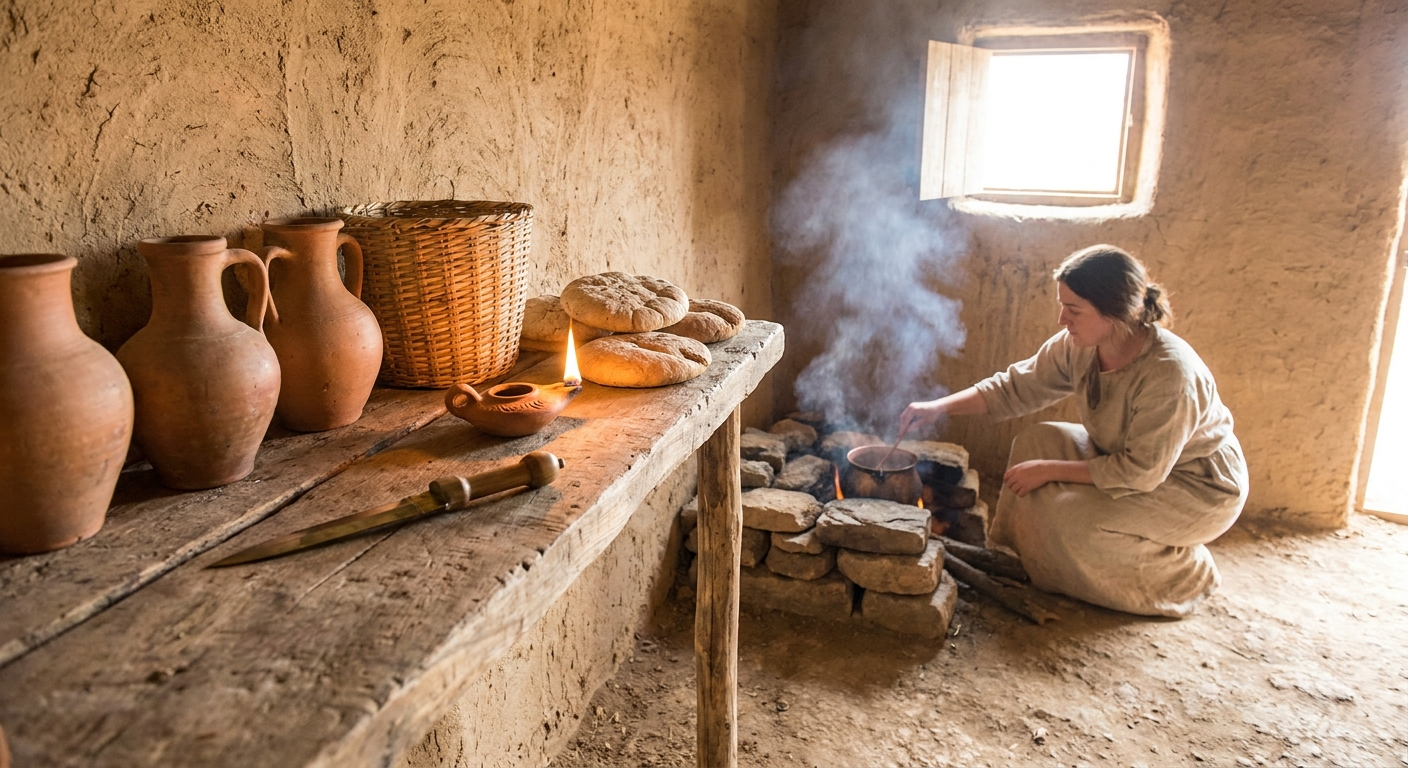
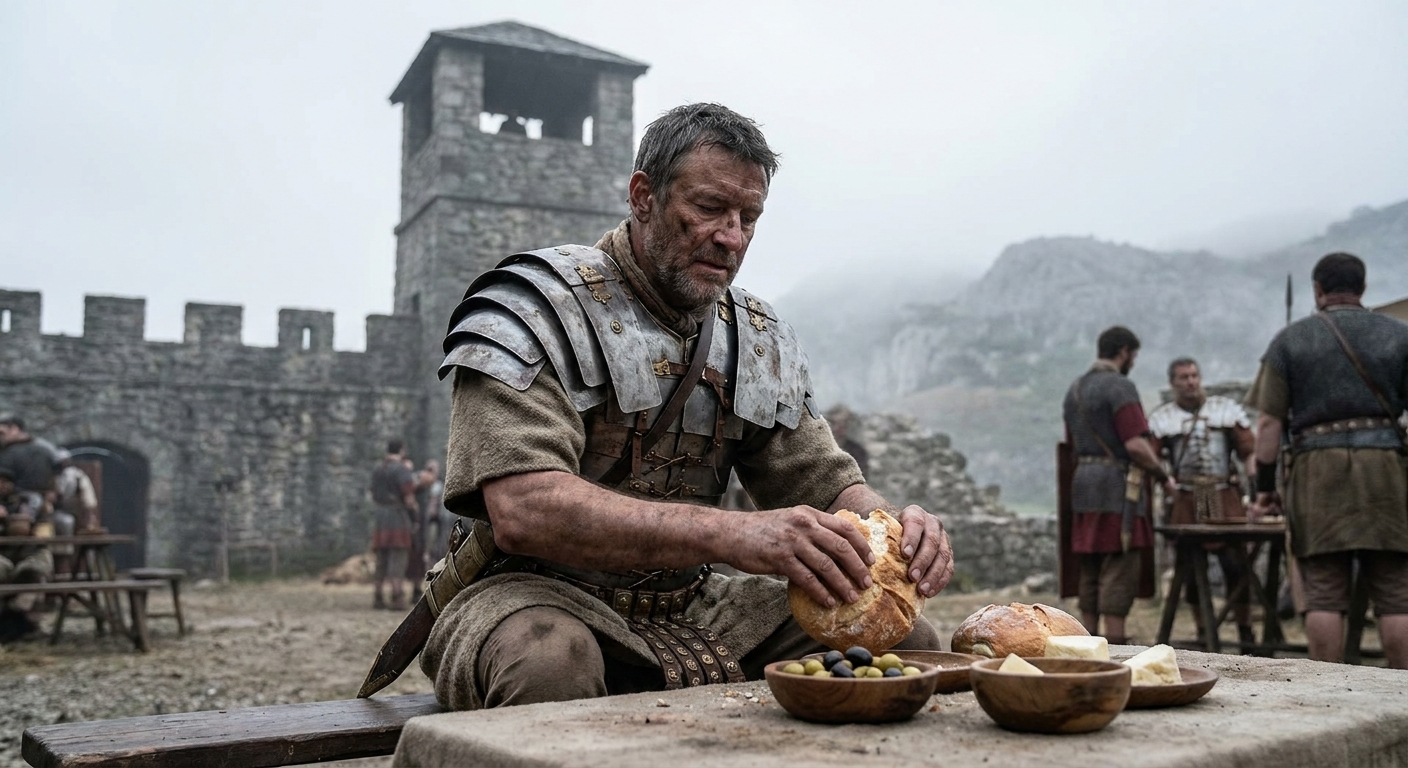
A typical breakfast (the ientaculum) was simple: leftover bread moistened with wine or dipped in olive oil, maybe accompanied by olives or cheese. In a small dwelling above a shop on Insula I.9, one might wake on a straw mattress, roll past a chest of clothes, and reach for yesterday’s bread stored in a ceramic jar.
We know what this bread was like from finds such as the famous loaf in the Museo Archeologico Nazionale di Napoli, branded with the name of its baker, Celer, slave of Quintus Granius Verus. Chemical analysis of Roman bread residues suggests a mix of wheat, barley, and sometimes broad beans, a far cry from the refined white loaves of modern grocery stores.
Water and Hygiene
Most apartments lacked private plumbing. The wealthy might have in‑house latrines and small baths, but the majority fetched water from public fountains. In Pompeii, over forty public fountains have been identified; lead pipes (fistulae) carried water from the aqueduct to these basins.
An inhabitant of Insula I.9 would likely descend narrow stairs, water jug in hand, walking past walls still bearing graffiti: electoral slogans, crude drawings, or lovers’ declarations. One such inscription, CIL IV 5296, casually records: "I was here with the girl from Nuceria"—an offhand reminder that ancient streets were as marked by personal presence as modern social media.
Midday: Work, Labor, and Social Ties
In the Workshop
By midmorning, primary activity moved into shops and workshops fronting the street. Archaeology reveals a dense clustering of specialized labor: fullers (cloth cleaners), dyers, metalworkers, tavern‑keepers, and many more. The Fullonica of Stephanus in Pompeii, for example, preserves basins where cloth was trampled in a mixture that likely included urine as a cleansing agent—an olfactory detail often omitted from romantic visions of antiquity.
A shopkeeper’s day involved a blend of production and retail. The recessed counters visible along many Pompeian streets functioned like permanent food trucks. In the thermopolia (hot‑food bars), dolia (large jars) sunk into masonry counters held prepared dishes—stews, lentils, and wine.
Literary sources support this picture. The poet Martial mentions street food and cheap taverns in his epigrams (e.g., Epigrams 1.41), while Seneca laments the moral implications of "low" dining places. Where moralists saw decadence, archaeologists see accessible calories and dense social networks.
Enslaved and Free
Any honest account of Roman daily life must grapple with slavery. The majority of labor in urban workshops involved enslaved people, whose experiences are only sporadically visible in the record. Chains, cramped servant quarters, and legal inscriptions (such as the Lex Petronia, curbing some forms of abuse) hint at lives spent in unfreedom.
Yet even here, small voices emerge. Manumission inscriptions—stone records of formerly enslaved people gaining freedom—appear frequently in cemeteries around Pompeii and Rome, such as the columbarium of the Statilii on the Esquiline Hill. They testify to complex household dynamics in which enslaved people could become freedpersons and even, over generations, citizens.
Afternoon: Religion, Leisure, and Obligation
Shrines at the Threshold
Religion was woven into daily action. Many households had lararia—small shrines dedicated to the household gods (Lares). Excavated lararia, with painted serpents and offerings, appear in both grand houses and modest dwellings.
An artisan returning home might pause briefly to place a bit of bread or wine at the shrine, invoking protection for the household. This was less about deep theology than about ritual maintenance, the same way many people today touch a charm or glance at a screenshot of a loved one before a demanding task.
Markets and Social Worlds
Afternoons might bring a visit to the forum or neighborhood market. Archaeologists have traced wear patterns on paving stones that show how traffic concentrated near certain shopfronts. At Ostia, the Piazzale delle Corporazioni with its mosaic advertisements testifies to an economy in which long‑distance traders advertised their specialties with visual icons—grain shipments from Africa, for instance.
Written sources fill in the texture: Petronius' Satyricon, though exaggerated and satirical, depicts freedmen boasting of their wealth, complaining about prices, and gossiping over a long banquet, reflecting recognizable social anxieties around status and consumption.
Evening: Home, Light, and Sleep
As darkness fell, lighting became precious. Archaeological finds show a proliferation of terracotta oil lamps, often decorated with mythological scenes or erotic imagery. The limited radius of these lamps meant that most tasks—reading, mending, eating—clustered tightly around their flickering circles of light.
A Roman evening meal, the cena, varied with status. For an ordinary inhabitant, it might consist of puls (a grain porridge), vegetables, maybe some salted fish or sausage. Excavations in Herculaneum have turned up preserved foodstuffs—nuts, figs, garum (fish sauce)—giving substance to textual descriptions.
Sleep came early by modern urban standards, in crowded rooms where privacy was scarce. Household composition—multiple generations, enslaved individuals, lodgers—blurred neat lines between "family" and "workplace".
How We Know: Evidence Behind the Reconstruction
This reconstructed day is not guesswork but synthesis, drawing on three main categories of evidence:
Archaeological remains
- Housing layouts from Pompeii, Herculaneum, and Ostia - Tools, ovens, mills, and workshops - Human remains bearing markers of diet and disease
Primary texts
- Satirists (Juvenal, Martial) complaining about noise, crowds, and food - Legal texts on property, slavery, and markets - Inscriptions: epitaphs, manumission records, shop signs
Ephemeral writing
- Graffiti in Pompeii and Herculaneum (published in the Corpus Inscriptionum Latinarum) - Wax tablets from places like Vindolanda on Hadrian’s Wall, preserving shopping lists, invitations, and personal letters
Cross‑checking these sources allows historians to align what people claimed about their lives with what the material record forces us to see.
Echoes in the Modern World
Many aspects of this Roman day feel distant: slavery as a legal norm, public latrines, reliance on open flames. Yet the underlying rhythms are familiar:
- The commute becomes a walk to the fountain and the shopfront.
- The office is a street‑facing workshop, part private, part public.
- The social feed is a wall of graffiti, filled with endorsements, insults, and half‑serious love notes.
- Status anxiety echoes in Martial’s jabs at parvenus and Petronius’ freedmen.
Understanding daily life in places like Insula I.9 forces a recalibration of what "Roman" means. Instead of marble and oratory, we find calloused hands, shared beds, and the persistent smell of baking bread.
Why Daily Life Matters More Than Battles
Battles and emperors are easy to memorialize; their dates fit cleanly into timelines. But the infrastructure of the ordinary—how people ate, slept, washed, worked, and talked—shapes history more deeply.
Studying Roman daily life through archaeological and textual fragments offers:
- A check against elitist narratives, by foregrounding non‑elite experiences.
- A deeper understanding of long‑term continuities—urban crowding, migration, informal economies.
- A reminder that our own "normal" is as historically contingent as theirs.
When you next wake to city noise, grab yesterday’s bread for breakfast, or glance at the scribbles on a public wall, you are closer to an inhabitant of Insula I.9 than marble statues would have you believe. The edge of empire, then as now, was built not only by soldiers and senators, but by people whose names rarely made it into the official record—yet whose days, painstakingly reconstructed, bring the ancient world startlingly near.