When a city falls in war, survivors tell stories—of treachery, heroism, divine wrath. Centuries later, archaeologists confront a different kind of record: collapsed walls, ash layers, arrowheads embedded in brick. Together, texts and ruins offer a composite narrative of urban destruction and resilience.
Introduction: Reading Ruins as Battle Reports
This article explores how three cities—Troy, Lachish, and Carthage—reveal the realities of conquest. By pairing primary sources with excavated evidence, we can see where legend aligns with material fact and where memory rewrites the past.
Troy: Between Epic and Earth
The Literary Troy
Homer’s Iliad presents the Trojan War as a decade-long siege culminating in a night of horror. In Book 22, as Hector falls, Priam cries out:
"My son, do not await that man's approach..."
— Iliad 22.38–39 (tr. Lattimore)
Later traditions add the famous wooden horse ruse and the city’s fiery destruction. For centuries, scholars debated whether Troy existed at all or was purely mythic.
The Archaeological Troy
Heinrich Schliemann’s controversial 19th-century excavations at Hisarlık in northwest Turkey identified a multi-layered settlement. Subsequent, more careful work by Wilhelm Dörpfeld, Carl Blegen, and modern teams reveals at least nine major occupation phases, Troia I–IX.
The prime candidate for Homeric Troy is Troy VIIa (c. 13th–12th century BCE). Its archaeological profile includes:
- Hasty rebuilding of walls.
- Storage jars crammed into houses, suggesting stockpiling.
- A destruction layer with widespread burning.
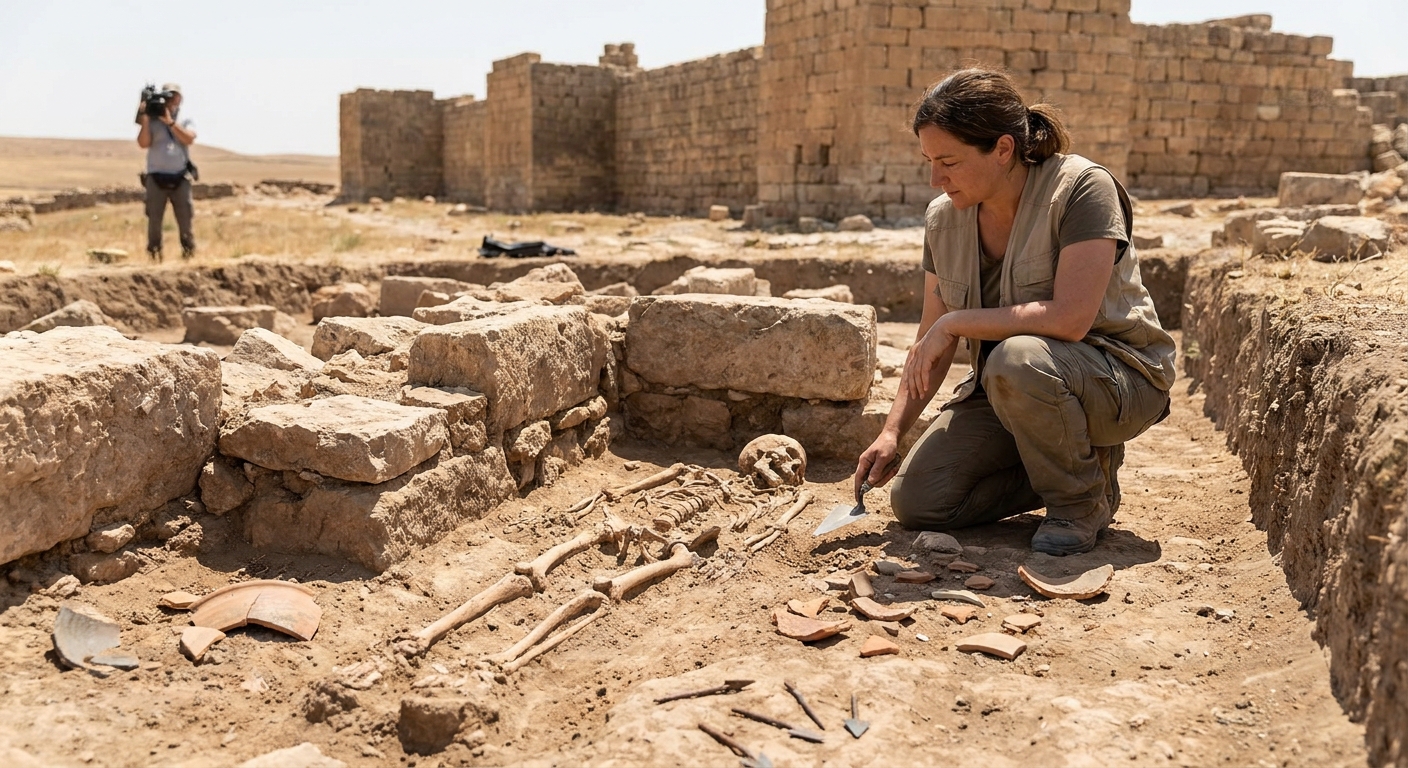
- Human remains in streets and collapsed buildings.
The combination suggests a violent end—whether from war, internal revolt, or a calamity exploited by enemies.
Text vs. Ruin
There is no wooden horse in the soil, but there is evidence of a besieged community under stress. The epic’s focus on individual heroes and gods occludes the logistics visible in storage jars and wall repairs. Yet the broader outlines—a wealthy city, a destructive conflict, fire—are supported by the archaeological record.
Troy demonstrates a pattern: literary sources dramatize; archaeology quantifies. The two correct and complicate each other.
Lachish: War in Relief and Ash
The Biblical and Assyrian Lachish
Lachish, a major Judean city, entered the textual record dramatically in the late 8th century BCE. The Hebrew Bible mentions its fall during the Assyrian campaign of Sennacherib (701 BCE):
"In the fourteenth year of King Hezekiah... the king of Assyria came up against all the fortified cities of Judah and captured them."
— 2 Kings 18:13 (NRSV)
The Book of Isaiah alludes to the threat and to Jerusalem’s narrow escape. On the Assyrian side, we have one of the most vivid royal propaganda pieces from the ancient world: Sennacherib’s palace reliefs at Nineveh. These carved panels, now in the British Museum, depict the siege of Lachish in detail—Assyrian archers, battering rams, impaled prisoners, deportees.
An inscription boasts:
"As for Hezekiah of Judah... I shut him up like a bird in a cage."
— Sennacherib’s Prism (COS 2.119)
The Excavated City of Lachish
Excavations at Tel Lachish, particularly the work led by James Starkey and later by Israeli teams, unearthed a massive destruction layer corresponding to the late 8th century BCE level (Level III):
- A breached city gate with signs of intense burning.
- Hundreds of iron arrowheads and sling stones concentrated along ramparts.
- Remains of a large Assyrian-style siege ramp built of stones and earth.
- Charred beams and collapsed buildings.
These finds visually confirm the tactics shown in the Nineveh reliefs: archery suppression, battering rams advancing up a constructed ramp, and structural collapse.
Among the most poignant discoveries are ostraca (inscribed potsherds) from a slightly later destruction, testifying to administrative correspondence in a city under threat.
Truth in Carved Stone
In Lachish, the propagandistic visuals of an Assyrian king align strikingly with the excavated reality. The reliefs are glorifying and selective—they minimize Assyrian casualties and exaggerate order—but the technical details of the siege are reliable.
This convergence allows scholars to reconstruct battle sequences with rare precision, making Lachish a key case study in how empires practiced urban warfare: methodical, brutal, and bureaucratically recorded.
Carthage: "Delenda Est" and the Archaeology of Erasure
The Roman Story of Carthage’s Fall
In 146 BCE, after three Punic Wars, Rome destroyed its North African rival, Carthage. Roman authors presented the act as both necessity and moral demonstration. Cato the Elder’s famous refrain in the Senate—
"Carthago delenda est" ("Carthage must be destroyed")
— Plutarch, Life of Cato the Elder 27
—framed total destruction as righteous policy.
Polybius, an eyewitness Greek historian accompanying the Roman general Scipio Aemilianus, describes the final days of Carthage’s siege:
"Scipio, looking down from the citadel upon the city, is said to have wept... reflecting on the destiny of all things human."
— Polybius, Histories 38.21 (fragments)
He reports systematic burning, slaughter, and enslavement.
Excavating a Supposedly Erased City
For centuries, tradition held that the Romans sowed Carthage with salt and left it permanently ruined. Archaeology has significantly revised this picture.
Excavations in modern Tunis and Carthage (notably by the UNESCO "Save Carthage" campaign) reveal:
- A distinct destruction horizon from the mid-2nd century BCE—burned structures, collapsed walls, and smashed pottery.
- Mass graves and indications of violent death in certain areas.
- Subsequent Roman urban layers, including a new forum, baths, and residential quarters.
Carthage was physically devastated, but it was not turned into eternal wasteland. Instead, it was rebuilt as a Roman colony, integrating its advantageous harbor and trade position into Roman imperial networks.
Ideology vs. Materiality
The Roman story emphasizes moral and political totality: Carthage’s defeat proves Rome’s destiny. The physical record reveals pragmatic reuse. Salt- sowing is likely apocryphal, a metaphor for annihilation transformed into pseudo-fact.
Carthage illustrates how victors narrate erasure while simultaneously exploiting the very spaces they claim to have obliterated.
Patterns of Urban Destruction in War
Across these case studies, several recurring features emerge:
- Destruction is selective, not absolute.
Even in catastrophic falls, not every building burns. Archaeological plans of Troy VIIa and Lachish show mosaics of survival and ruin. Strategic targets—gates, palaces, granaries—receive concentrated violence.
- Warfare is entangled with economic logic.
The storage jars in Troy, the administrative ostraca at Lachish, the Roman reuse of Carthage’s harbor—all point to food, trade, and taxation as underlying motives.
- Narratives tend to exaggerate moral absolutes.
Homer dwells on heroic deaths. Biblical and Assyrian sources frame events as divine judgment or royal might. The material record reveals mundanities—half-collapsed homes, lost tools—that undercut neat moralizing.
- Reoccupation is common.
Few cities vanish permanently. New peoples, new regimes, new architectural plans arise over ruins. Tell sites in the Near East—layered mounds of occupation—are physical reminders that defeat is often a chapter, not an endpoint.
Lessons for the Modern World
Contemporary urban warfare—in Aleppo, Mosul, Mariupol—is documented in real time by satellites and smartphones. Yet the interpretive battles look familiar:
- Governments and insurgents compete to frame destruction as either necessary, surgical, or barbaric.
- Reconstruction proposals stress renewal while often masking demographic and political engineering.
Archaeologists of the future will encounter reinforced concrete instead of mudbrick, but they will still read impact craters, burn patterns, and reused foundations. They will also sift through digital archives: social media posts, drone footage, leaked reports.
The ancient cases remind us that:
- Claims of total destruction usually conceal continuities of power and infrastructure.
- Survivor narratives and victor propaganda both require critical comparison with physical evidence.
Conclusion: Cities as Palimpsests of Conflict
Standing amid the exposed walls of Troy or the siege ramp at Lachish, one confronts the blunt fact that cities are built with an awareness—implicit or explicit—that they might someday be attacked. The thickness of ramparts, the placement of gates, the choice of citadel locations are all preemptive dialogues with potential enemies.
Archaeology does not replace written history; it argues with it. When we read Homer against the burned rubble of Troy VIIa, or Sennacherib’s reliefs against the arrowheads of Lachish, we gain a fuller sense of how war reshapes urban life—and how states, ancient and modern, craft narratives to make sense of devastation.
In every collapsed wall there is both an ending and an intention to begin again. The ruins of Troy, Lachish, and Carthage thus speak not only of conquest, but of the stubborn human habit of rebuilding atop the scars of war.