Around 2600 BCE, while pyramids rose along the Nile and Sumerian kings boasted of battles in cuneiform, a different kind of urban experiment flourished along the Indus and Saraswati river systems.
Introduction: The Silent Cities of the Indus
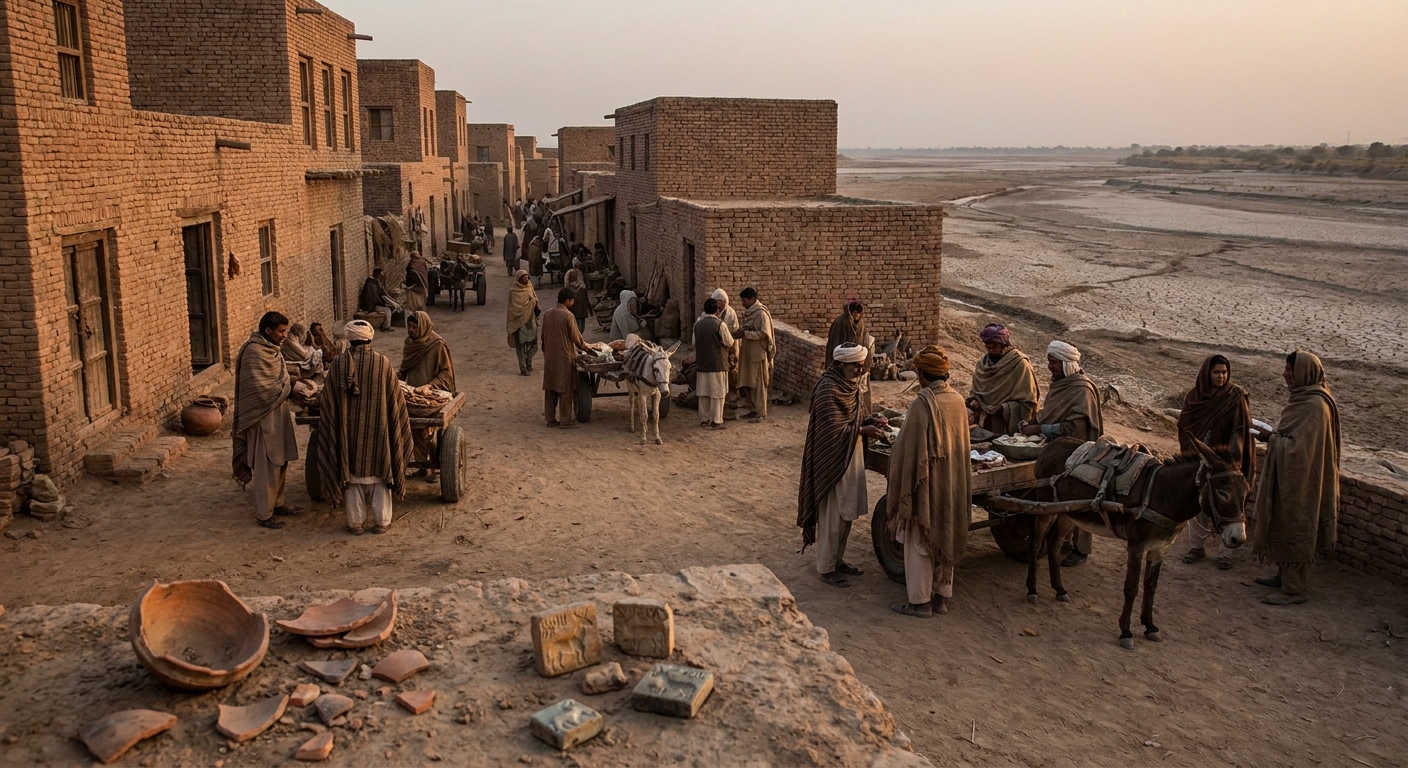
At Harappa, Mohenjo-daro, Dholavira, and dozens of other sites, people built cities of baked brick, gridded streets, and sophisticated drains. They traded with Mesopotamia and crafted beads so fine that modern jewelers still marvel at them.
Yet the Indus Valley Civilization (also known as the Harappan Civilization) remains one of the world’s most enigmatic lost empires—or perhaps more accurately, lost urban cultures. Its script is undeciphered; its kings, if it had any, unnamed.
What we do have is archaeology: bricks, beads, bones, and the faint stains of vanished wooden roofs. From these, scholars have begun to tease out not just a chronology but a set of lessons about how complex societies can organize themselves, prosper, and eventually unravel.
This list-style essay offers five key insights, each grounded in material evidence and connected, briefly, to our contemporary world.
1. You Can Build Big Without Building in the Name of a God-King
One of the most striking features of Indus cities is what they lack.
At Mohenjo-daro, excavators discovered the so‑called “Great Bath”—a brick-lined pool, about 12 by 7 meters, waterproofed with bitumen and accessed by broad staircases. Nearby stood large halls, granary-like structures, and elevated citadels.
What they did not find were colossal statues of rulers, royal tombs, or monumental temples akin to those in Egypt or Mesopotamia.
Across major sites, we see:
- Standardized brick dimensions (often in a 1:2:4 ratio) used over vast areas.
- Carefully laid-out street grids, oriented to cardinal directions.
- Public works—drains, wells, platforms—that required coordinated labor.
Yet there is no single palace dominating the skyline, no inscription trumpeting a “King of the Four Quarters.”
Some scholars, like Jonathan Mark Kenoyer, argue that this suggests a different kind of political organization—perhaps corporate councils or assemblies, a more distributed elite, or religious authorities less centered on single personalities.
For modern observers, the Indus case challenges the assumption that early cities must grow under the shadow of autocratic god-kings.
2. Clean Streets, Deep Drains: Public Health as Urban Ideology
If there is a signature of the Indus cities, it is the drain.
At Mohenjo-daro, Harappa, and Rakhigarhi, excavations reveal:
- Covered brick drains running beneath main streets, with inspection shafts.
- Household latrines connected to soak-pits or drains.
- Abundant wells—some cities had hundreds—often shared by neighborhoods.
This system was not improvised. It reflects planning and maintenance over centuries.
We do not possess Indus texts detailing sanitary regulations, but the consistency of design across sites suggests shared norms or centralized guidelines. Archaeologist Gregory Possehl has described this as an “urban ethos” of cleanliness and order.
Why does this matter today? Cities in the 21st century still struggle with wastewater, disease vectors, and fair access to clean water. The Indus record shows that 4,500 years ago, urban societies were already investing in collective infrastructure at a scale that put daily bodily needs—bathing, washing, defecation—at the center of civic design.
3. Globalization Is Older Than We Think: Long-Distance Trade Without Conquest
Indus seals—small, often square steatite objects carved with animals (bulls, elephants, unicorn-like figures) and short inscriptions—have turned up as far afield as Mesopotamian sites like Ur and Susa.
Cuneiform texts from Mesopotamia reference a place called Meluhha, believed by many scholars to be the Indus region. A tablet from the reign of the Akkadian king Naram-Sin mentions Meluhha goods; Gudea of Lagash (c. 2144–2124 BCE) boasts of importing “gold dust of Meluhha” for temple construction.
Archaeology confirms these connections:
- Carnelian beads from the Indus, identified through manufacturing marks and chemical signatures, found in Sumerian contexts.
- Mesopotamian cylinder seals discovered in the Indus region.
- Possible Meluhhan trading quarters in Mesopotamian port cities, inferred from texts mentioning “Meluhhan interpreters.”
Yet, unlike later empires, the Indus civilization leaves no trace of military garrisons, conquest narratives, or fortifications projecting power into foreign lands. Its external reach appears commercial, not coercive.
In our era of globalized supply chains and debates over “soft power,” the Indus case offers a deep-time example of extensive trade networks built, as far as we can tell, without imperial military footprints.
4. Scripts Can Die, But Questions Remain
Indus seals and tablets bear one of the world’s earliest writing systems—but one that remains undeciphered.
Typical inscriptions are brief, often 4–8 signs, with a repertoire of roughly 400–600 distinct characters (counts vary by classification). They occur on:
- Stamp seals (used possibly to mark ownership or shipments).
- Tiny copper tablets.
- Pottery and tools.
Despite numerous attempts, no bilingual “Rosetta Stone” has been found. The short length of most texts and the lack of clear sign repetition patterns make decipherment difficult.
Debates rage over whether the script encodes a Dravidian language, an early Indo-Aryan, or something else entirely. Some have even suggested it might be a non-linguistic symbol system, though this is contested.
The loss of this script is not just a philological puzzle. It means we have no direct statements from Indus people about law, religion, or governance—no royal boasts, no hymns, no contracts we can read.
Instead, we rely on indirect evidence: standardized weights hint at regulated trade, seal motifs at shared mythologies.
For modern societies, whose data are increasingly digitized, the Indus silence is a cautionary tale. Scripts and formats can become unreadable within centuries. Without active transmission and translation, even well-developed information systems can vanish into archaeological opacity.
5. Collapse Isn’t Always a Catastrophe—Sometimes It’s a Slow Drift
Between roughly 1900 and 1300 BCE, many Indus cities were abandoned or radically transformed. This is often called the civilization’s “collapse,” but the picture is more complex.
Archaeological indicators include:
- Decline in standardized weights and measures; local variants emerge.
- Diminished long-distance trade, evidenced by fewer foreign goods.
- Shift in settlement patterns, with populations moving eastward toward the Ganges plain.
- Change in material culture, such as new pottery styles and house forms.
Climate proxies—like oxygen isotope data from Arabian Sea sediments and Himalayan lakes—suggest episodes of weakened monsoons during this period. Less reliable rainfall would have stressed the floodplain agriculture underpinning urban life.
Yet there is little evidence of massive destruction layers or widespread violence at major sites. Instead, we see gradual de-urbanization: big cities shrink or empty; villages proliferate.
People adapted. Farming communities persisted, cultural traits endured, and later South Asian civilizations inherited and reworked some Indus legacies—brick architecture, motifs, perhaps elements of ritual.
In contrast to cinematic visions of apocalypse, the Indus story shows how a complex system can transition into another mode of organization—less centralized, less monumental—over generations.
For us, facing climate shifts and questions about the sustainability of megacities, the Indus arc suggests that “collapse” can be, at least in part, a reconfiguration.
Tying the Indus Past to Our Present
Why should we care about a civilization with no known kings, unreadable texts, and cities long turned to dust?
- Alternative Models of Complexity: The Indus example broadens our imagination about how big societies can function—potentially with more horizontal structures and fewer personality cults.
- Infrastructure as Culture: Drains, wells, and standardized bricks speak of values as much as utility. How we shape the built environment reflects what we collectively prioritize.
- The Fragility of Information: An entire writing system can become mute within a few centuries if not actively remembered. Our own archives, increasingly digital, require intentional preservation strategies.
- Adaptation to Climate Variability: The drift from urbanism to village life along the Indus was likely painful but survivable for many communities. Understanding those processes can inform modern resilience planning.
Further Reading and Key Excavations
To explore more deeply:
- Kenoyer, Jonathan Mark. Ancient Cities of the Indus Valley Civilization. Oxford University Press, 1998.
- Possehl, Gregory L. The Indus Civilization: A Contemporary Perspective. Rowman Altamira, 2002.
- Wright, Rita P. The Ancient Indus: Urbanism, Economy, and Society. Cambridge University Press, 2010.
Key sites open to visitors and ongoing study include Harappa and Mohenjo-daro in Pakistan, Dholavira and Rakhigarhi in India. Walking their gridded streets, one can still trace the outlines of a civilization that proves an empire—or something like one—need not shout its sovereignty to shape history.