In 612 BCE, the walls of Nineveh, capital of the Neo-Assyrian Empire, shook under the assault of Babylonian and Median forces. For more than two centuries, Assyria had dominated the Near East with iron weapons, siege engines, and a sophisticated system of roads and provincial governors.
Introduction: When the Center Cannot Hold
By the time the dust settled, the empire that once boasted, in the words of King Ashurnasirpal II, “I smashed their corpses like clay pots,” was gone. Within a few generations, its palaces lay buried under their own rubble. Greek authors remembered Assyria only as a distant, semi-legendary tyranny.
Today, fragments of Assyrian bas-reliefs hang in museums from London to Los Angeles; streaming documentaries pan across their carved lion hunts. But what can this lost superpower tell us about our own?
This explainer draws on primary sources and archaeological evidence to unpack how the Neo-Assyrian Empire was built, how it unraveled—and why its story continues to resonate in a world of global networks and brittle hegemonies.
How to Build a Superpower: Assyrian Statecraft 101
1. Centralized Violence, Carefully Documented
Assyrian kings did not shy away from publicizing brutality. Royal inscriptions, carved on stone slabs and cylinders, revel in terror as a policy tool.
Consider this boast from Ashurnasirpal II (9th c. BCE), inscribed on his palace wall at Kalhu (Nimrud):
> “I felled with the sword 800 of their combat troops ... I built a pillar over against the city gate, and I flayed all the chief men ... and I covered the pillar with their skins.”
> — Ashurnasirpal II, Standard Inscription
These were not private diaries; they were displayed on palace walls and stelae. Archaeological excavations at Kalhu and Nineveh have uncovered hundreds of such inscriptions, many still coated with the original bolt-holes that once fixed them to plastered walls.
The message to subject peoples was clear: resistance would be met with exemplary violence. Yet this was only one pillar of Assyrian power.
2. An Empire of Roads and Records
Assyria pioneered a highly integrated provincial system. From the 9th to 7th centuries BCE, kings like Tiglath-pileser III and Sargon II reorganized conquered territories into provinces overseen by governors (bēl pāhāti) who reported directly to the king.
Key tools of control included:
- Royal Road Network: Excavations and textual references point to an extensive system of roads connecting cities like Nineveh, Kalhu, Dur-Sharrukin, and Assur. Relays of mounted couriers could carry messages rapidly across the empire.
- Administrative Tablets: At Nineveh, the Southwest Palace of Sennacherib and the North Palace of Ashurbanipal have yielded thousands of clay tablets: tax records, land grants, letters. These reveal a bureaucratic machine tracking labour, tribute, and troop movements.
A letter from a provincial official to the king, found in the Nineveh archives (K 75), frets over local unrest:
> “To the king, my lord, your servant Nabu-ušallim: Good health to the king, my lord. The city is restless; the men grumble about the corvée. I have written to you so that you may instruct me.”
The daily anxieties of empire—tax burdens, troop levies—hum beneath the grandiose inscriptions.
3. Deportation and Demographic Engineering
Assyrian kings forcibly relocated hundreds of thousands of people. This was not random cruelty; it was strategic statecraft.
In the annals of Sargon II, detailing the conquest of Samaria in 722 BCE, we read:
> “I besieged and conquered Samaria. I carried off 27,290 of its inhabitants. I took from them 50 chariots ... I settled people from lands I had conquered in the midst of it.”
Archaeological surveys in northern Mesopotamia and the Levant show new settlement patterns and material cultures—pottery styles, house forms—that reflect these mass movements.
The goal: break local power bases, fortify border regions, and create mixed communities less likely to rebel. The cost: deep resentment and long-term instability.
The Glittering Capital: Nineveh in Its Prime
At its height, Nineveh covered some 700 hectares, ringed by walls over 12 kilometers long. Excavations by Austen Henry Layard in the 1840s and subsequent digs have revealed a cityscape of palaces, temples, gardens, and canals.
Sennacherib’s “Palace Without Rival”
King Sennacherib (r. 704–681 BCE) transformed Nineveh into a showcase of imperial glory. In his own words:
> “I made its dimensions larger than before. I widened its squares and streets and enlarged the foundations of its dwellings. I made its population greater than ever before.”
> — Sennacherib Prism
His Southwest Palace, dubbed by archaeologists the “Palace Without Rival,” featured:
- Miles of reliefs depicting lion hunts, siege warfare, and tribute processions. Many of these now reside in the British Museum.
- Waterworks that diverted the Khosr River through the city, with aqueducts such as the one at Jerwan—massive stone arches bearing cuneiform inscriptions—testifying to hydraulic engineering.
One relief panel from Nineveh shows engineers crossing a river on inflated animal skins, towing rafts laden with building timber. It is a visual manual of logistics and ambition.
The World’s First Royal Library?
Ashurbanipal (r. 668–c. 627 BCE), Sennacherib’s grandson, styled himself a scholar-king. In his palace at Nineveh, he amassed a collection of thousands of tablets—literary, scientific, magical, and administrative.
Among these were copies of the Epic of Gilgamesh, omen texts, medical treatises, and lexical lists. One colophon proudly states:
> “Palace of Ashurbanipal, king of the universe, king of Assyria, to whom Nabu and Tašmetu have given broad ears and opened eyes to see the inscribed tablets.”
This library, excavated in the 19th century and now largely housed in the British Museum, preserves much of what we know about earlier Mesopotamian literature. The empire that burned cities also curated knowledge.
Why Assyria Fell: Beyond “Overstretch”
The Neo-Assyrian Empire did not fade gently; it imploded within a few decades. Several interlocking factors emerge from the evidence.
1. Permanent War Fatigue
Assyrian kings boasted of annual campaigns. In the annals of Tiglath-pileser III and Sargon II, year after year lists of sieges, tributary kings, and plunder unfold.
Archaeologically, this militarization appears in:
- Fortified frontier cities like Dur-Katlimmu, with massive walls and garrisons.
- Weapon hoards and mass graves at battle sites.
But constant war meant constant strain—on manpower, resources, and legitimacy. Letters from Nineveh’s archives complain of shortages and conscription burdens. Subjects may tolerate oppression; endless mobilization is harder to sustain.
2. Succession Crises and Elite Fragmentation
Assyrian politics were vicious. Palace coups, fratricide, and usurpation were recurrent.
When Ashurbanipal died, a power struggle between his sons and brothers appears to have weakened central authority. Babylonian chronicles (the Babylonian Chronicle ABC 3) record internal strife that left Assyria vulnerable just as external foes rallied.
Provincial magnates, enriched by war and land grants, may have formed semi-autonomous power blocs. Administrative tablets show large estates accumulating in fewer hands.
3. Coalition Warfare: When Nemeses Compare Notes
Babylonia, long under Assyrian domination, became the core of a coalition with the Medes and others.
The Babylonian Chronicle for the years 616–609 BCE tersely reports the campaign against Assyria:
> “In the month Abu, the king of Akkad and the king of the Medes ... attacked Nineveh. They made a great slaughter ... they carried off the vast booty of the city and the temple and turned the city into a ruin heap.”
Excavations at Nineveh and Assur show burn layers, collapsed walls, and smashed sculptures consistent with violent destruction.
4. Environmental and Economic Stress
Although the data are more limited than for later periods, some paleoclimate proxies suggest shifts in rainfall patterns in northern Mesopotamia in the late 7th century BCE. Agricultural stress would have compounded the pressures of war and overextension.
Diminishing marginal returns from conquest—less easily plundered wealth, more rebellious provinces—may have undermined the empire’s economic engine.
Echoes in the Modern World
The Neo-Assyrian story is not a template but a mirror, reflecting dynamics that still shape global politics.
Information Control and Narrative Warfare
Assyrian kings curated their image through inscriptions and reliefs. They monopolized monumental storytelling, though private letters and foreign chronicles sometimes puncture the façade.
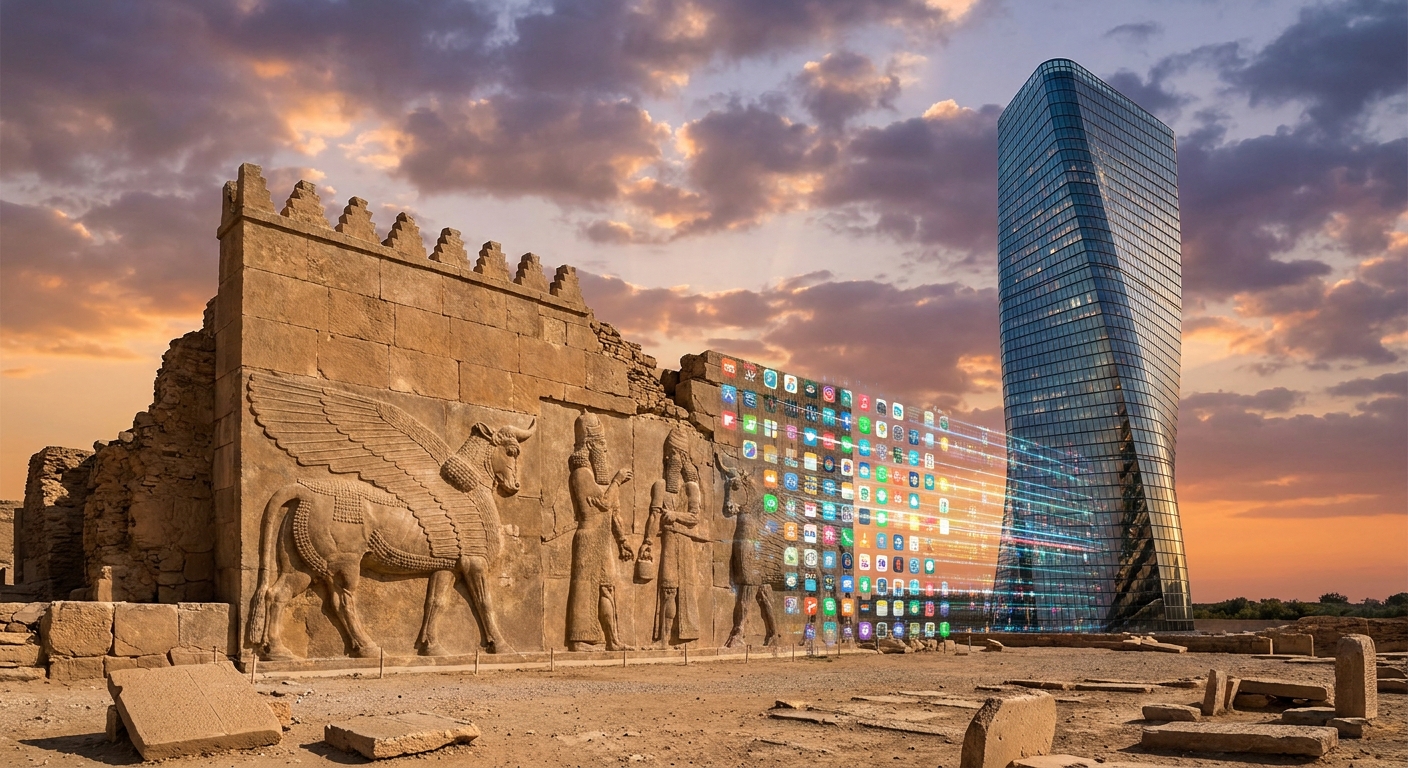
Today, states deploy social media, news cycles, and strategic leaks in analogous ways. The tension between curated self-image and deeply archived reality is enduring; our “tablets” are servers rather than clay, but the stakes are similar.
Militarized Hegemony and Its Limits
Assyria demonstrates how a model based on incessant coercion and resource extraction can generate dramatic, short-term dominance—and equally dramatic collapse.
Comparative historians, from Paul Kennedy to Joseph Tainter, use Assyria as one data point among many in analyzing “imperial overstretch” and the costs of complexity.
Heritage Under Threat
In the 21st century, sites like Nimrud and Nineveh have suffered new waves of destruction—from looting in the wake of the 2003 Iraq War to deliberate iconoclasm by ISIS.
Ironically, 19th‑century removal of artifacts to European and American museums, driven by imperial appropriation, has also functioned as a form of preservation. The ethics of this “salvage” are hotly debated, informing restitution claims and new models of shared curation.
Primary Sources and Further Reading
For those wishing to engage more directly with the Assyrian record:
- Grayson, A. Kirk. Assyrian Rulers of the Early First Millennium BC (RIMA 2–3). University of Toronto Press.
- Luckenbill, Daniel D. Ancient Records of Assyria and Babylonia. 2 vols. University of Chicago Press.
- Kuhrt, Amélie. The Ancient Near East c. 3000–330 BC. Routledge, 1995.
- Radner, Karen. Ancient Assyria: A Very Short Introduction. Oxford University Press, 2014.
When we watch empires project power today—hard and soft, digital and kinetic—we would do well to remember the stone kings of Nineveh, once certain they ruled “from the Upper to the Lower Sea.” Their ruins, and their words, suggest that no architecture of dominance is permanent, but that the records it leaves can speak across millennia.