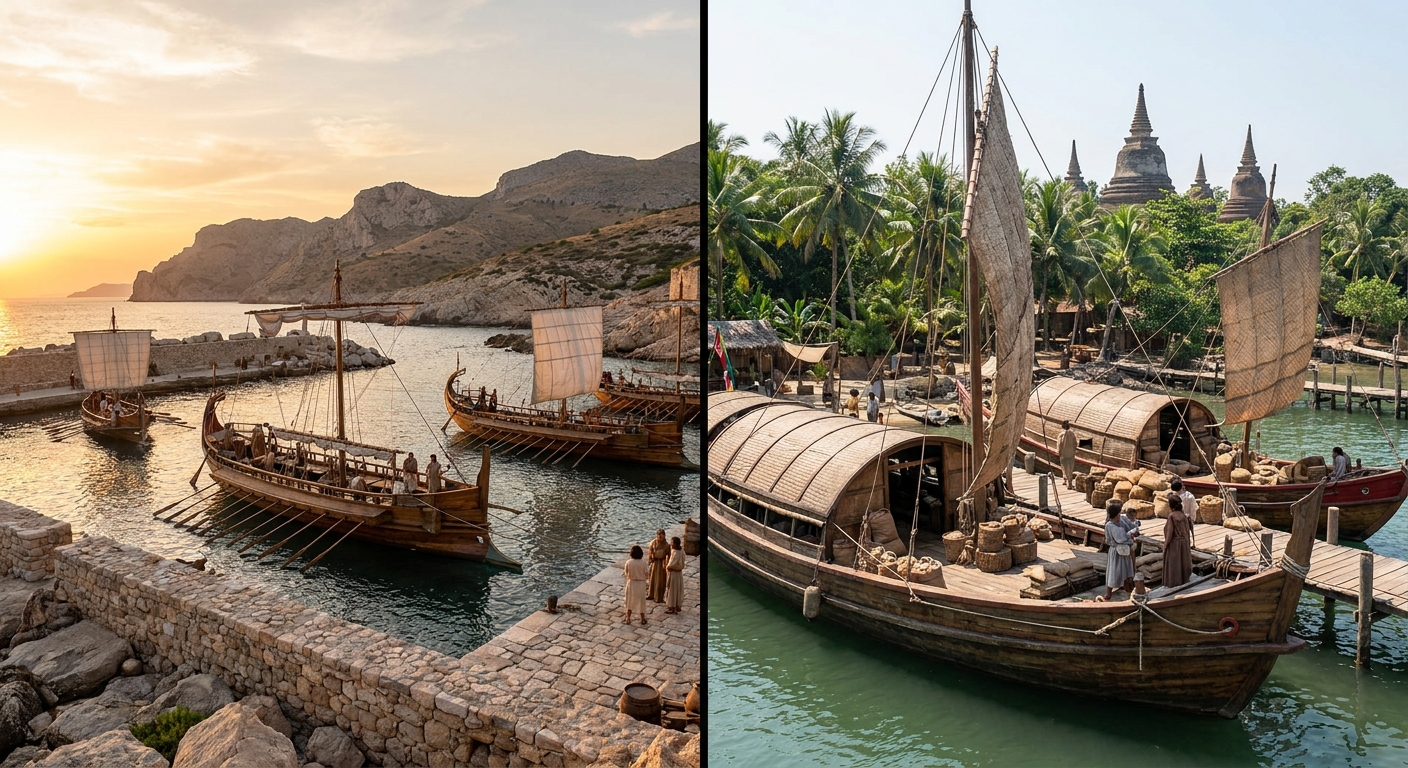
Most people picture empires as landbound: legions on roads, cavalry on steppe, walls on frontiers. But some of the most influential lost empires were thalassocracies—maritime powers whose strength lay less in conquered hinterlands than in control of sea lanes.
Introduction: When Power Floated on Water
Two such polities, though separated by half the globe and more than a millennium, invite comparison: the Phoenician city-states of the first millennium BCE in the Mediterranean and the Srivijaya polity that dominated parts of Island Southeast Asia from roughly the 7th to 13th centuries CE.
Both now lie partially obscured: Phoenicia buried under modern coastal cities, Srivijaya under silted river mouths and patchy chronicles. Yet inscriptions, shipwrecks, and scattered texts allow us to reconstruct their oceanic reach.
This comparative essay traces how these sea empires rose, how they operated, and why they faded—and considers what their stories reveal about our own age of global shipping and contested choke points.
1. Geography as Destiny: Narrow Coasts and Maritime Bottlenecks
Phoenicia: Thin Land, Deep Harbors
The Phoenician cities—Tyre, Sidon, Byblos, Arwad—clung to the narrow Levantine coast, squeezed between the Mediterranean and the Lebanon Mountains.
Archaeology at Tyre and Sidon, though challenged by continuous habitation, reveals:
- Sheltered harbors, some artificially enhanced.
- Workshops for purple-dye production, evidenced by heaps of crushed murex shells.
- Early iron-age pottery and architecture linking them to Canaanite predecessors.
Limited arable land encouraged outward orientation. Timber from the Lebanon ranges (notably prized by Egyptian and Mesopotamian rulers, as known from the Amarna letters) and luxury crafts became the basis for maritime trade.
Srivijaya: Controlling the Straits
Srivijaya’s heartland lay around Palembang in Sumatra, at the mouth of the Musi River, close to the Strait of Malacca—one of the world’s great maritime chokepoints.
Chinese sources like the Tang dynasty chronicle Xin Tang Shu describe a polity called Shilifoshi (Srivijaya) that controlled sea routes between China and India.
Archaeological and epigraphic evidence includes:
- Old Malay inscriptions in Pallava script, such as the Kedukan Bukit inscription (c. 683 CE), found near Palembang. It boasts of a royal expedition and the establishment of a kadatuan (realm).
- Remains of wooden structures, ceramics, and imported goods along now-silted waterways, suggesting a riverine-maritime settlement complex.
If Phoenicia was a narrow coastal strip made for harbors, Srivijaya was a web of rivers perfectly positioned to tax and protect passing shipping.
2. Ships, Navigation, and the Technology of Reach
Phoenician Hulls and Hypothetical Circumnavigations
Classical authors, notably Herodotus, credit Phoenicians with ambitious voyages. Herodotus reports that around 600 BCE, under Pharaoh Necho II, Phoenician sailors may have circumnavigated Africa, returning via the Pillars of Heracles (Gibraltar). Modern scholars debate the story’s veracity, but it captures perceptions of Phoenician seamanship.
Archaeological evidence from shipwrecks—like the 8th‑century BCE wreck at Bajo de la Campana off Spain—shows:
- Stout, shell-first constructed hulls, assembled with edge-joined planks and mortise-and-tenon joints.
- Mixed cargoes of metals, ingots, glass, and luxury items.
Phoenician mastery of long-distance navigation, possibly using coastal landmarks and stellar bearings, underpinned a trading arc from the Levant to the Atlantic coasts of Iberia and Morocco.
Srivijayan Lancaran and Monsoon Mastery
In Southeast Asia, Srivijaya thrived on monsoon rhythms. Seasonal winds, reversing direction annually, allowed predictable round-trip voyages between China, Southeast Asia, and India.
While no clearly Srivijayan ship has been excavated whole, regional wrecks and depictions (like the Borobudur reliefs in Java) show:
- Large ocean-going outrigger vessels with multiple sails.
- Sewn-plank and lashed-lug construction techniques typical of Austronesian boatbuilding.
Chinese records, such as the account of the Buddhist monk Yijing (I‑Tsing), who stayed in Srivijaya around 671 CE en route to India, praise local seamanship. Yijing wrote:
> “Shih-li-fo-shih [Srivijaya] is a great center for Buddhist studies. Those who wish to go to the West should stay here for some time and practice the rules of discipline.”
His sojourn underscores Srivijaya’s role as both a maritime hub and an intellectual waypoint.
3. Trade as Empire: Timber, Purple, Spices, and Dharma
Phoenician Commercial Webs
Phoenician city-states established trading posts and colonies across the Mediterranean:
- Carthage in modern Tunisia, founded by Tyre (according to later tradition, c. 814 BCE).
- Settlements in Sardinia, Sicily, southern Spain, and North Africa.
Material signatures include:
- Phoenician amphorae for wine and oil.
- Characteristic red-slip pottery.
- Inscriptions in the Phoenician alphabet.
They traded:
- Timber and metals from the Levant and Cyprus.
- Luxury goods: purple-dyed textiles, glass, carved ivory.
- Possibly agricultural products from colonies back to eastern homelands.
Alphabetic writing, developed from earlier West Semitic scripts, became a key Phoenician export. Greek adoption and adaptation of this script in the early 1st millennium BCE laid the groundwork for much of the world’s subsequent writing systems.
Srivijaya’s Buddhist and Commercial Networks
Srivijaya sat astride the main route for Chinese ceramics, silk, and coin heading west, and cloves, camphor, resins, and other Southeast Asian products moving east.
Chinese court records mention multiple Srivijayan embassies bringing tribute and receiving titles and gifts. This “tribute trade” system, while framed as ritual subordination, functioned in practice as regulated commerce.
Religiously, Srivijaya was a center of Mahayana Buddhism. Yijing described monasteries there as flourishing, with many monks studying Sanskrit and Buddhist texts before continuing to Nālandā in India.
The Talang Tuwo inscription (684 CE), issued by Srivijayan ruler Śrī Jayanāśa, records the establishment of a park and expresses a wish that beings who visit might attain enlightenment—a revealing blend of royal patronage, ecological concern, and Buddhist aspiration.
4. Political Forms: City-Leagues vs. Riverine Mandalas
Phoenician City-Leagues and Loose Confederation
Phoenician polities were primarily independent city-states, occasionally forming leagues but rarely uniting permanently.
Assyrian records shed light on their politics from the outside. Inscriptions of kings like Shalmaneser III and Tiglath-pileser III list Tyre, Sidon, Byblos, and others among tributary states.
For example, an inscription of Tiglath-pileser III (744–727 BCE) reads:
> “I received tribute from Kushtashpi of Kummuh ... Hiram of Tyre, Sibitti-Bi’li of Byblos.”
These cities were commercially powerful but militarily vulnerable; they often navigated great empires by diplomacy and payment rather than open defiance.
Srivijaya’s Mandala: A Fluid Sphere of Influence
Srivijaya did not control a compact territorial state but a mandala—a Southeast Asian political concept describing a center of power surrounded by concentric spheres of influence.
Old Malay inscriptions speak of a dātu or kadātuan (realm), but boundaries were porous. Coastal and riverine settlements owed allegiance and provided ships or troops when required, in return for protection and access to trade.
Javanese inscriptions and Chinese records sometimes present Srivijaya alongside other regional powers, such as Śailendra in Java, indicating a competitive multipolar landscape rather than unchallenged supremacy.
Politically, Srivijaya functioned more as a maritime hegemon—a broker of routes and rituals—than as a land empire with straight-lined borders.
5. Fading from the Sea: How Thalassocracies Lose Their Grip
Phoenicians: From Independence to Assimilation
From the late 8th century BCE onward, Phoenician cities fell under successive imperial overlords:
- Assyrians, then Babylonians (notably Nebuchadnezzar II’s long siege of Tyre).
- Persians, under whom Phoenician fleets served as crucial naval components.
Herodotus notes that Phoenician ships fought in the Persian fleet at Salamis (480 BCE). After Alexander the Great’s siege and partial destruction of Tyre in 332 BCE, Greek and later Roman cultural frameworks increasingly dominated the region.
Archaeologically, we see continuity in urban occupation but shifts in material culture and language use. Phoenician identity persisted locally, but the independent thalassocracy faded into a provincial role within larger empires.
Srivijaya: Silting Rivers and Shifting Routes
Srivijaya’s decline is less precisely documented but can be traced through:
- Chola raids from south India in the 11th century CE, recorded in the Tamil inscription of Rajendra Chola I at Tanjavur. These expeditions attacked Srivijayan ports, capturing rulers and disrupting trade.
- Gradual silting of river channels around Palembang, reducing navigability.
- The rise of rival ports, such as those in Java (e.g., Majapahit) and on the Malay Peninsula.
Chinese records note a decline in Srivijayan missions and a rise of other polities in the same maritime zone. Buddhism’s center of gravity in the region also shifted.
Unlike land empires toppled by dramatic conquests, Srivijaya seems to have ebbed away as trade routes, river courses, and political alliances changed—a reminder that in maritime worlds, control is as fluid as water.
Modern Parallels: Chokepoints, Soft Power, and Cultural Legacies
The stories of Phoenicia and Srivijaya feel uncannily contemporary.
- Chokepoints: Control of the Strait of Malacca remains geopolitically vital, much as in Srivijaya’s day. The Mediterranean narrows—Gibraltar, Suez—recall Phoenician straits and islands.
- Soft Power through Culture and Ideas: Phoenicians spread an alphabet; Srivijaya transmitted Buddhist learning. Today, nations export media, standards, and educational institutions alongside goods.
- Vulnerability to Route Shifts: When overland or alternative sea routes rise (think Arctic passages or rail corridors), port-centric economies must adapt or decline.
Both thalassocracies also leave enduring cultural footprints:
- The Phoenician alphabet, adapted by Greeks, Latins, and many others, underlies scripts used today from Europe to the Americas.
- In Indonesia and Malaysia, place names, ritual practices, and linguistic traces preserve memories—however transformed—of the maritime polities that once mediated between India, China, and the island world.
Primary Sources and Further Reading
To delve deeper into these sea empires:
Phoenicians
- Aubet, Maria Eugenia. The Phoenicians and the West. Cambridge University Press, 2001.
- Markoe, Glenn. Phoenicians. University of California Press, 2000.
- Translations in Hallo, William W., and K. Lawson Younger Jr. (eds.). The Context of Scripture, especially inscriptions from Tyre and Sidon.
- Manguin, Pierre-Yves, et al. (eds.). Early Interactions between South and Southeast Asia. ISEAS, 2011.
- Wolters, O. W. History, Culture, and Region in Southeast Asian Perspectives. Cornell University SEAP, 1999.
- Translations of Yijing in Li Rongxi (tr.). Buddhist Pilgrim-Monks as Agents of Cultural and Artistic Transmission. Numata Center, 2014.
Srivijaya
In recovering these forgotten thalassocracies, we are reminded that empire need not ride on horses or rest on stone walls. Sometimes it floats—fragile yet far-reaching—on planks, monsoon winds, and the willingness of strangers in distant ports to trade.