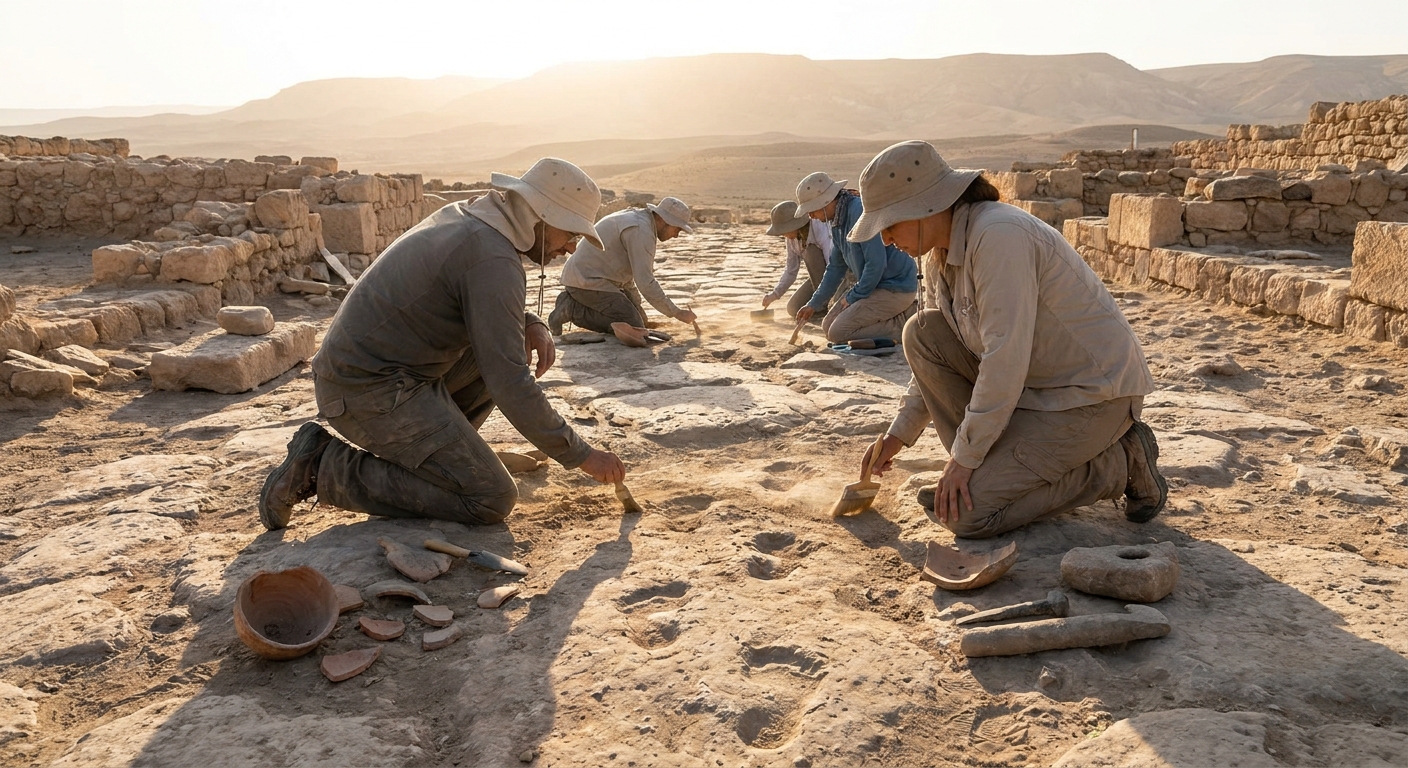
The stereotype is persistent: archaeology as a series of heroic dives for golden idols, chased by rolling boulders. Real archaeology is slower, more meticulous, and—if you enjoy puzzles and patient observation—far more interesting.
Archaeology Is Not Indiana Jones
This guide walks through how archaeology actually works, from choosing a site to interpreting the past, using real examples and primary sources to ground each step. Whether you’re a prospective student, an avid history podcast listener, or a curious traveler, you’ll see how archaeologists turn dirt and debris into historical arguments.
1. Asking a Question: Archaeology Begins with Why
Archaeology is not about digging for its own sake; it starts with a research question.
Examples of good archaeological questions:
- How did a small Roman frontier fort integrate local communities?
- When and how did maize agriculture reach the American Southwest?
- What did daily life look like for enslaved people on a specific plantation?
An instructive historical model comes from Heinrich Schliemann, whose obsession with Homer’s Iliad led him to excavate at Hisarlik in Turkey in the 1870s. Schliemann sought "the city of Priam"—a dramatic question, but a misleadingly simple one.[^1]
Modern archaeologists refine such myths into testable sub-questions:
- Is there evidence of a Late Bronze Age citadel destroyed by war or earthquake?
- How do material remains compare to Homer’s descriptions, composed centuries later?
Archaeology thus sits at the intersection of texts, landscapes, and theoretical models.
2. Choosing and Surveying a Site
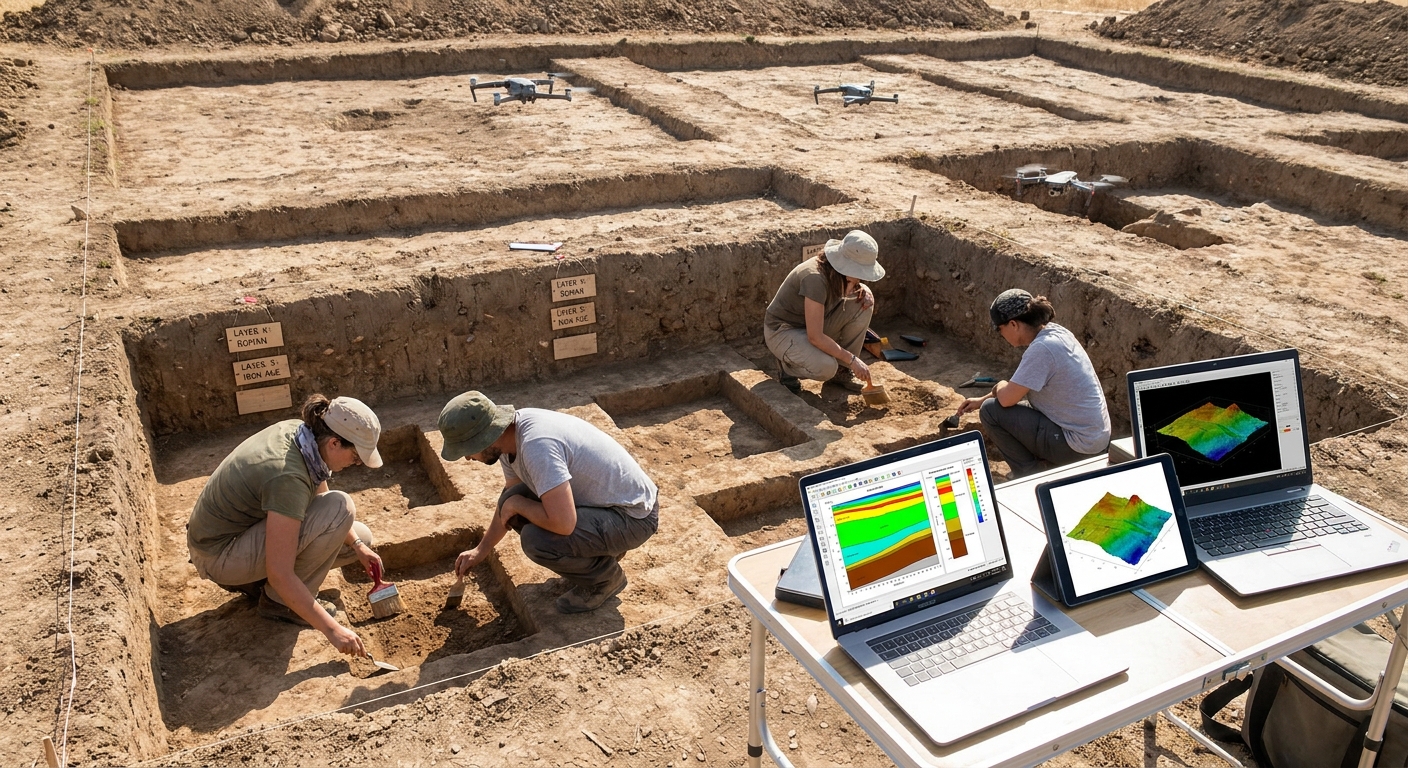
Before a single trowel is lifted, archaeologists survey. They walk the landscape, consult historical maps, talk to local communities, and now frequently deploy drones and geophysical tools.
Surface Survey
Systematic walking—"fieldwalking"—records artifacts visible on the ground. At the Boeotia survey in Greece, teams collected and mapped pottery fragments, revealing dense Classical-period farmsteads in areas previously thought empty.[^2]
Geophysical Survey
Methods like magnetometry, ground-penetrating radar (GPR), and electrical resistivity detect subsurface anomalies:
- At Falerii Novi in Italy, GPR revealed an entire Roman town plan—streets, temples, shops—without excavation.[^3]
- In the UK, magnetometry has mapped Iron Age roundhouses beneath ploughed fields.
Survey helps refine questions: are you looking at a town, a farm, a cemetery, or a ritual site?
3. Excavation: Controlled Destruction
Excavation is paradoxical: to uncover a site is to destroy it. You only get one chance. That’s why documentation is as crucial as discovery.
The Basics of a Trench
- Gridding: The site is divided into squares (e.g., 5×5 m) linked to a coordinate system.
- Stratigraphic excavation: Layers are removed in reverse order of deposition, with each layer (or "context") recorded separately.
- Tools: Trowels, brushes, sieves, and occasionally heavier machinery for overburden.
Kathleen Kenyon’s work at Jericho in the 1950s popularized the Wheeler–Kenyon method: deep, narrow trenches preserving vertical "baulks" of unexcavated earth as profiles. This allowed her to clarify the Neolithic and Bronze Age sequence and challenge biblical chronologies of the city’s fall.[^4]
Recording Everything
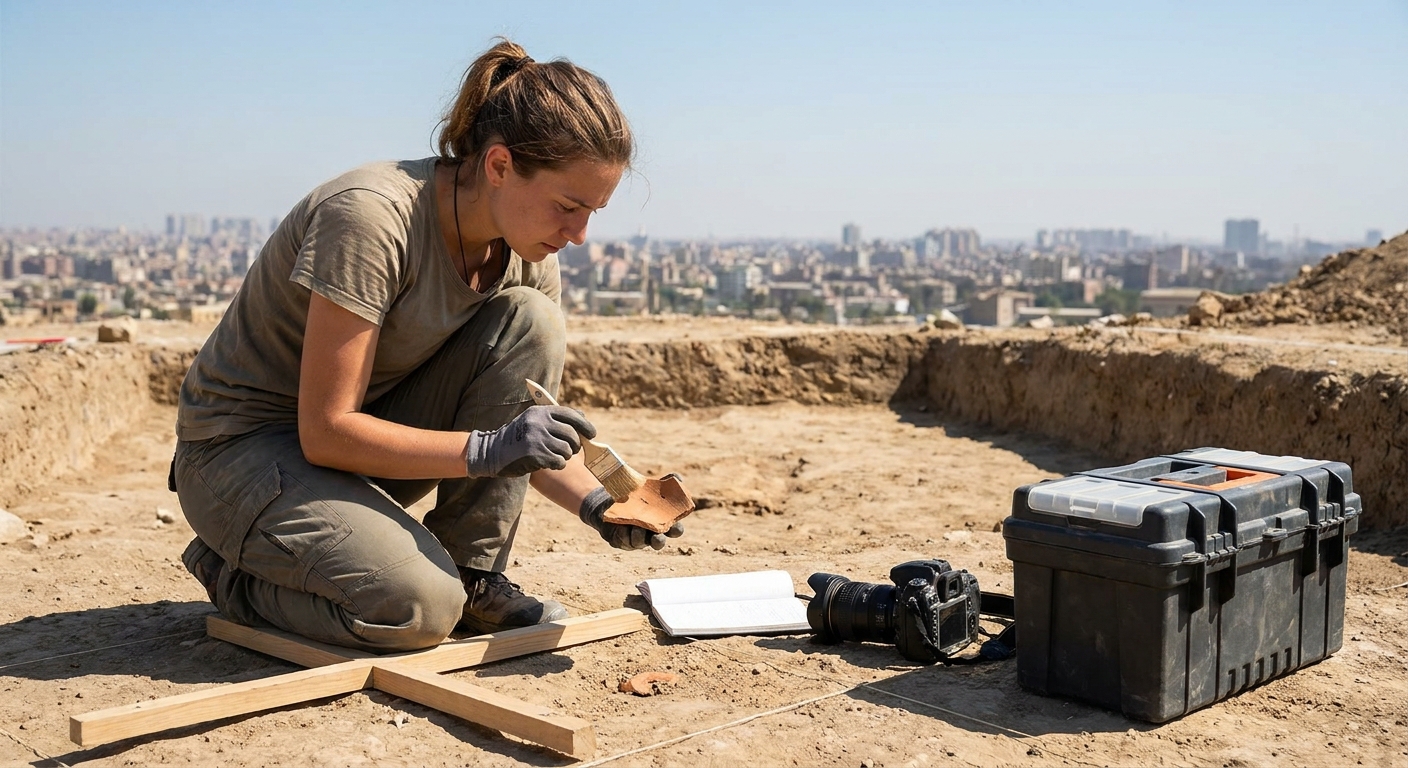
As each context is removed, archaeologists:
- Draw plans and sections.
- Photograph features.
- Collect soil samples.
- Bag and label artifacts with precise coordinates and context numbers.
The aim is to be able to reconstruct the site on paper (or screen) long after it is gone.
4. Post-Excavation: The Real Work Begins
Television ends with the dramatic "find." Archaeology continues into the lab, often for years.
Sorting and Cataloging
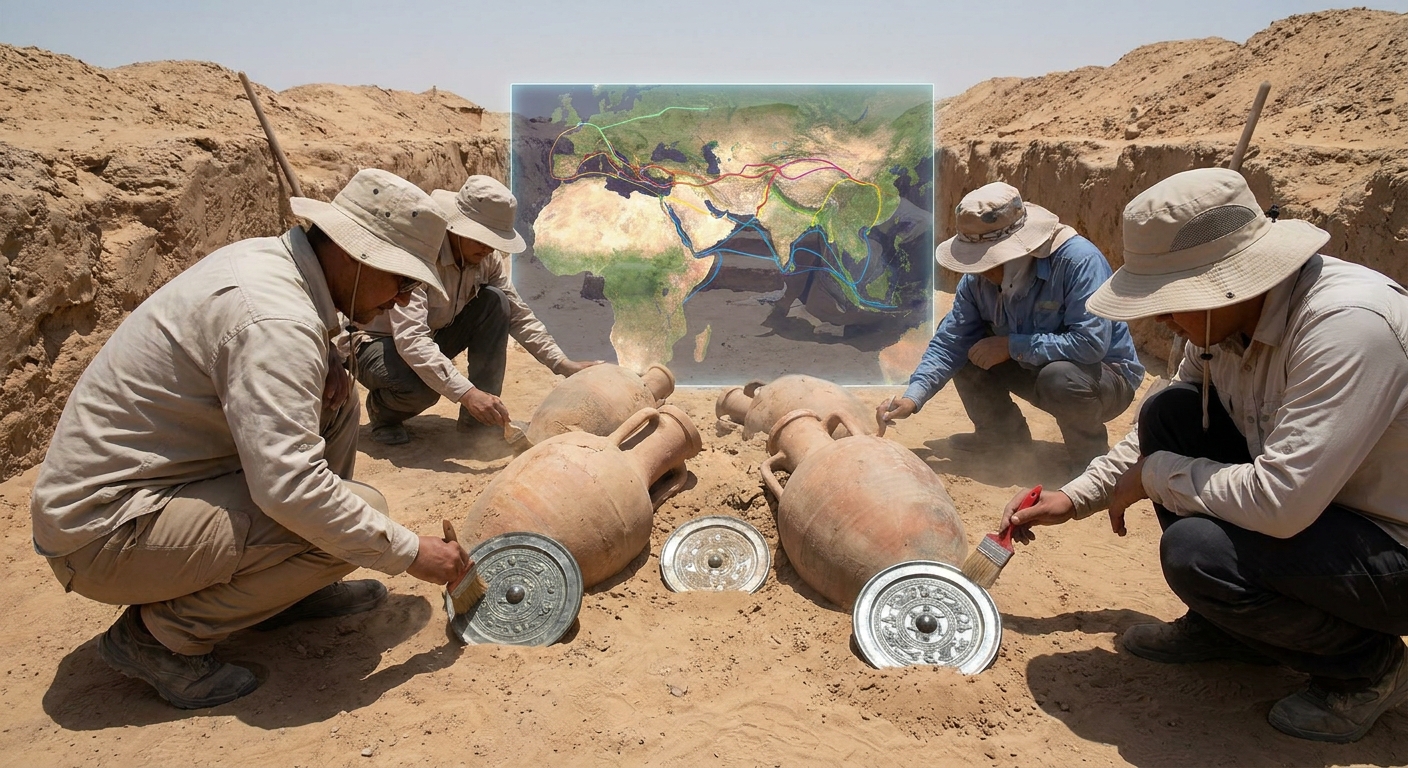
- Ceramics are washed, sorted by fabric and form, and compared to typological sequences.
- Lithics (stone tools) are classified by manufacturing technique and use-wear.
- Bones are identified by species and element.
Typology—established sequences of styles—is a powerful dating tool. Flinders Petrie, working in Egypt in the 1890s, pioneered "sequence dating" based on pottery development, showing that even modest graves could form a chronological backbone.[^5]
Specialist Analyses
- Radiocarbon dating of organic materials.
- Isotope analysis of teeth and bones for diet and mobility.
- Residue analysis on pottery for traces of wine, oil, milk, or resins.
- Micromorphology (thin-section analysis) of floors and sediments.
Each specialist report adds a piece to the puzzle.
5. Interpretation: From Data to Narrative
Interpretation is where archaeology meets storytelling. Yet it must remain grounded in evidence.
Example: A Roman Fort on the Frontier
Suppose you excavate a small fort along Hadrian’s Wall in Britain.
Finds include:
- Writing tablets (like those at Vindolanda) mentioning a "birthday party invitation" and requests for extra cloaks.[^6]
- Locally made pottery in native styles.
- Animal bones suggesting a heavy diet of beef and some imported delicacies.
- A shrine combining Roman and local deities.
From this, you might infer:
- A mixed community of soldiers, families, and locals.
- Cultural blending in food and religion.
- A climate cold enough to merit complaint in letters home.
Primary sources like the Notitia Dignitatum (a late Roman administrative list) might help identify the unit stationed there, but everyday letters give more insight into lived experience.
Good interpretation:
- Makes clear what is certain, plausible, or speculative.
- Links site-level data to broader regional or theoretical debates.
- Remains open to revision as new evidence emerges.
6. Ethics: Whose Past Is It?
Digging up the dead and their possessions raises ethical questions.
Human Remains
Many countries now have strict regulations governing excavation, study, and reburial. Indigenous groups, notably in North America under NAGPRA (Native American Graves Protection and Repatriation Act), have asserted rights to ancestors’ remains and grave goods.
Archaeologists must balance scientific interest with community values and descendant voices.
Looting and the Antiquities Market
Demand for "ancient art" fuels looting. The case of the Euphronios Krater—smuggled from Italy in the 1970s and later repatriated from New York’s Metropolitan Museum—highlighted how museum collections can be entangled with illicit excavation.[^7]
Responsible archaeology now emphasizes:
- Working closely with local communities.
- Publishing promptly and openly.
- Opposing the illicit trade in artifacts.
7. How You Can Get Involved (Responsibly)
You don’t need a PhD—or a fedora—to engage with archaeology.
Field Schools and Volunteer Programs
Many universities and heritage organizations run field schools that accept beginners. Participants learn:
- Basic excavation techniques.
- Recording and finds processing.
- Site preservation principles.
Always seek projects that are:
- Legally permitted.
- Affiliated with reputable institutions.
- Transparent about research goals.
Community and Public Archaeology
In cities like London, community dig programs involve residents in uncovering local history beneath playgrounds or parking lots. In the U.S., descendant community-led projects at plantation sites recenter enslaved people’s experiences.
Digital Participation
You can contribute to projects that crowdsource tasks like:
- Transcribing excavation notebooks and early site plans.
- Tagging objects in digitized museum collections.
- Classifying satellite imagery to identify potential sites.
Platforms like Zooniverse’s "Ancient Lives" (for papyri) or "GlobalXplorer" (for satellite imagery) turn micro-tasks into macro knowledge.
8. Archaeology’s Relevance Today
Why should any of this matter in an age of satellites and gene editing?
- Long-term perspective: Archaeology offers data on how societies coped with climate shifts, plagues, and resource stress over thousands of years.
- Everyday voices: It recovers the lives of people rarely named in texts: farmers, children, enslaved workers, artisans.
- Challenging myths: It tests national and religious narratives against material evidence—sometimes confirming, often complicating them.
The 19th-century excavator Austen Henry Layard, marveling at Assyrian reliefs from Nineveh, wrote:
> "The ruins of Nineveh ... tell us not only of the power and magnificence of the great kings, but of the people over whom they ruled."
> — Layard, Nineveh and Its Remains (1849)
Modern archaeology extends that insight worldwide. From a worked flint in a ploughed field to a lidar map of a jungle metropolis, it reconstructs human creativity and fragility alike.
You may never wield a trowel on a windswept tell, but you can read site reports, support ethical museums, question simplistic historical claims, and treat the ground beneath your feet as layered with stories. Archaeology is not about relics; it is about relationships—between people and places, then and now.
[^1]: Schliemann, H. (1881). Ilios: The City and Country of the Trojans.
[^2]: Bintliff, J. et al. (2007). The Theban and Boeotian Survey. British School at Athens.
[^3]: Vermeulen, F. et al. (2020). Complete GPR Survey of the Roman City of Falerii Novi. Antiquity.
[^4]: Kenyon, K. (1957). Digging Up Jericho. Ernest Benn.
[^5]: Petrie, W. M. F. (1899). Sequences in Prehistoric Remains. Journal of the Anthropological Institute.
[^6]: Bowman, A. (1994). Life and Letters on the Roman Frontier: Vindolanda and Its People. British Museum Press.
[^7]: Watson, P., & Todeschini, C. (2006). The Medici Conspiracy: The Illicit Journey of Looted Antiquities. PublicAffairs.