The ancient Maya are often framed in terms of mystery and collapse: enigmatic glyphs, jungle‑choked temples, a vanished people. Yet millions of Maya descendants live today across Mexico and Central America, speaking related languages and practicing traditions that bridge past and present.
Introduction: Rethinking a “Lost” Civilization
Rather than treating the Maya as a vanished curiosity, this article asks a different question: What did Classic Maya civilization (c. 250–900 CE) get right—in astronomy, urbanism, record‑keeping, and resilience—and what can those strengths teach us now?
Using inscriptions, codices, and archaeological findings, we will draw four broad lessons.
Lesson 1: Skywatching as Civic Science
Reading the Stars in Stone and Bark
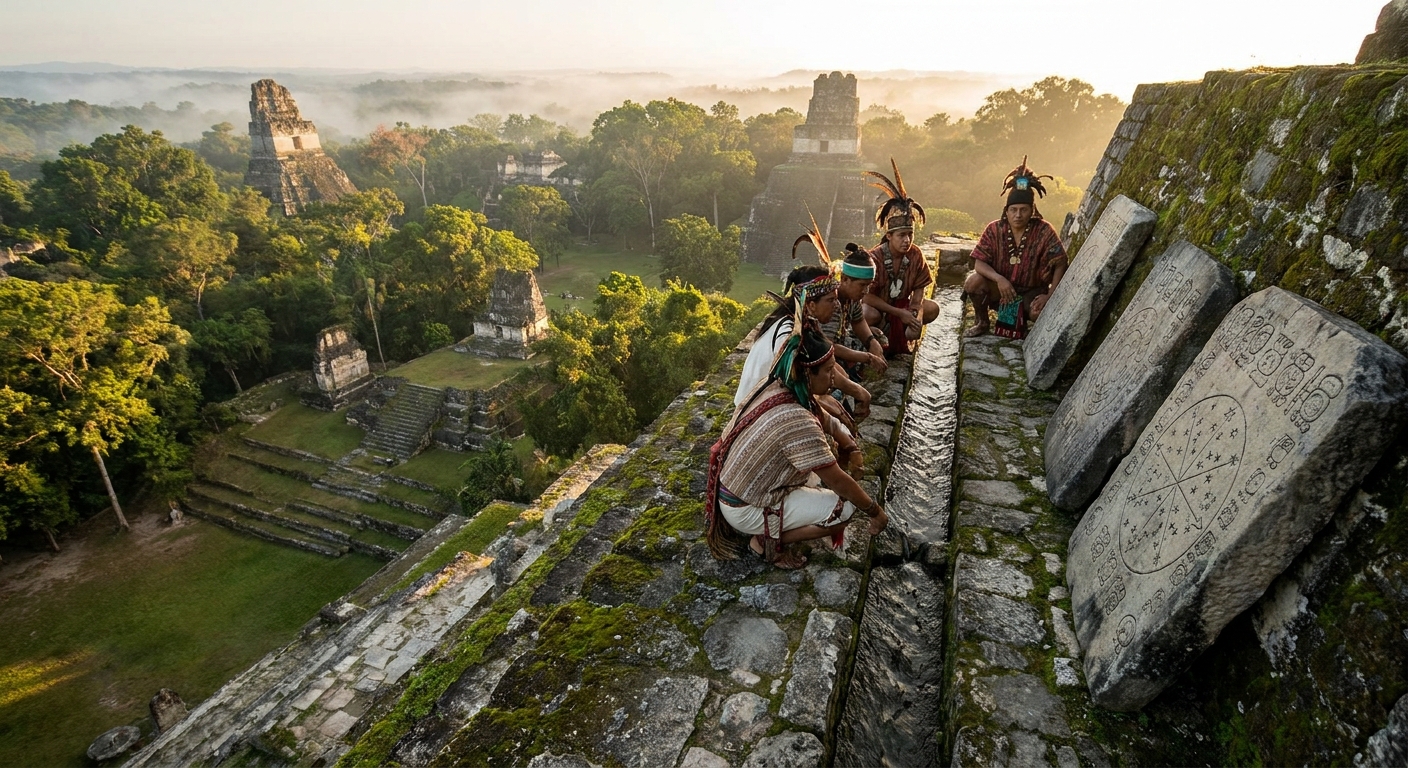
The Maya invested extraordinary care in observing the heavens. Their cities orient solar alignments into stone; their scribes folded astronomical tables into painted codices.
Primary sources include:
- The Dresden Codex: a pre‑Columbian Maya screenfold book containing detailed Venus tables and eclipse predictions
- Stelae (carved stone monuments) with Long Count dates tying historical events to celestial cycles
One page of the Dresden Codex, as reconstructed by scholars, tracks the 584‑day synodic cycle of Venus and notes when the planet becomes visible as morning or evening star—a cycle linked to war and ritual.
The inscription on Stela 31 at Tikal, for example, opens with a precisely dated Long Count entry:
> “On 8 Ajaw 8 Kumk’u… was the seating of the god.”
> (Tikal Stela 31, translation after Martin & Grube)
These dates can be converted into our Gregorian calendar using astronomical correlations, revealing historical events anchored to eclipses and planetary motions.
Modern Resonance
The Maya demonstrate that sustained, communal observation of nature can be both sacred and empirical. Their skywatching was not "science" in a modern secular sense—but it was systematic, predictive, and publicly meaningful.
In an era wrestling with climate data and long‑term risk, the Maya example suggests that making cycles visible—through monuments, media, and shared rituals—can anchor collective planning. When a city’s very plaza encodes solstices, it is harder to ignore the rhythms of the environment.
Lesson 2: Cities in the Forest, Not Against It
Urbanism Without Clear Streets
For decades, jungle‑covered ruins led scholars to imagine Maya cities as isolated temple complexes. Systematic mapping and, more recently, airborne LiDAR (Light Detection and Ranging) have overturned that picture.
LiDAR surveys in Guatemala’s Petén region, for instance, have revealed:
- Extensive causeway networks linking major centers
- Dense residential terraces and platforms beyond ceremonial cores
- Check dams, canals, and reservoirs for water management
Cities like Tikal, Calakmul, and Caracol emerge as low‑density urban sprawls—"green cities" diffused through forest rather than paved over it.
Archaeological Evidence of Agro‑Urban Mosaics
Pollen analysis and soil studies reveal that the Maya heavily modified their landscape:
- Elevated fields in wetlands
- Terraced hillsides to prevent erosion
- Managed orchards of useful trees (ramon, cacao, avocado)
Yet even at their most crowded, Classic Maya cities maintained green space within and around dwellings. House compounds included gardens; urban boundaries blurred into cultivated forest.
Modern Resonance
Maya urbanism challenges the opposition between “city” and “nature.” Their agro‑urban mosaics resemble contemporary visions of sustainable, decentralized cities with integrated food production.
This is not to romanticize the Maya; deforestation and soil degradation contributed to stress in some regions, particularly in the Late Classic. But the baseline model—a city interlaced with green infrastructure, rainwater harvesting, and diversified production—offers an alternative to concrete‑dominated urbanism.
Lesson 3: Writing as Time‑Weaving
From Stone Monuments to Bark Books
Maya hieroglyphic writing, deciphered largely in the late 20th century, blends logograms and syllabic signs. It was used to:
- Record dynastic history on stelae, altars, and stairways
- Inscribe personal names and titles on pottery
- Compose longer texts in codices (few of which survive)
The Temple of the Inscriptions at Palenque, for example, contains a long text chronicling the life and death of the king K’inich Janaab’ Pakal. On his sarcophagus lid, carved imagery and glyphs connect his burial to cosmic trees and celestial cycles.
A typical historical passage might read:
> “On 9.12.11.12.10, 9 Ok 18 K’ayab’, he was born, K’inich Janaab’ Pakal…”
> (Temple of the Inscriptions, Palenque)
This intertwining of personal biography with cosmic count situates individuals within deep time.
Time as a Network, Not a Line
The Maya used multiple calendars simultaneously:
- The 260‑day ritual calendar (Tzolk’in)
- The 365‑day solar calendar (Haab’)
- The Long Count, tracking days from a mythic zero date (August 11, 3114 BCE, in one correlation)
Events could be positioned in several overlapping cycles, emphasizing recurrence and resonance rather than a simple linear progression.
Modern Resonance
In a world where digital feeds prioritize the immediate and ephemeral, Maya record‑keeping suggests a different philosophy: inscribe key events in durable media and tie them to long cycles.
Practically, this might look like:
- Building institutions that track environmental and social indicators over centuries
- Designing public rituals around long‑term goals (e.g., 50‑year urban plans)
The Maya remind us that how we write time shapes how we inhabit it.
Lesson 4: Resilience Through Diversity—and Its Limits
A Patchwork of Polities
Classic Maya civilization was never a single empire. It comprised dozens of city‑states, allied, feuding, and intermarrying.
Primary sources like emblem glyphs on monuments identify distinct polities: Mutul (Tikal), Kaan (Calakmul), Baakal (Palenque), and many others. Stelae record warfare, captives, and marriage alliances.
This political fragmentation meant:
- No single point of failure
- Multiple centers experimenting with different responses to stress
When drought episodes struck (supported by speleothem records and lake sediments) and some major centers declined or were abandoned, other regions persisted or even flourished.
Collapse as Transformation
Archaeological evidence from places like Copán shows gradual depopulation, elite upheavals, and shifts in building patterns, not a single apocalyptic event. Households adapted by changing crops, moving locations, or reconfiguring community structures.
Meanwhile, Maya people did not vanish. Colonial‑period documents like the Popol Vuh (a K’iche’ Maya text recorded in the 16th century) preserve mythic and historical traditions reshaped under new pressures.
Modern Resonance
The Maya experience illustrates both the strengths and limits of resilience.
Strengths:
- Political diversity and decentralization can provide flexibility.
- Deep cultural traditions (language, ritual, ecological knowledge) can outlast particular urban forms.
Limits:
- Regional climate shifts and overtaxed environments can overwhelm even sophisticated systems.
- Elite competition may hinder coordinated responses to shared threats.
For a 21st‑century world facing climate change and political fragmentation, the Maya offer a sobering but not hopeless mirror.
Conclusion: Listening to the Maya on Their Own Terms
Archaeologists, epigraphers, and Maya communities have, over the past century, pulled Classic Maya civilization into sharper focus. We now see not a vanished enigma, but a complex tapestry of cities in forests, astronomer‑priests, farmers, artisans, scribes, and rulers.
Their achievements—in civic skywatching, integrated urban landscapes, time‑weaving writing, and flexible but vulnerable political mosaics—do not map neatly onto modern categories. Yet they pose sharp questions for us:
- How can observation of natural cycles be made public and meaningful?
- What would a city look like if designed with its ecosystem?
- How might we inscribe our stories in media meant to last centuries?
- Can political diversity be a resource rather than a recipe for paralysis?
To take the Maya seriously is to treat them not as a morality tale of "mysterious collapse" but as interlocutors across time—people who faced their own forms of risk and change with tools we are only beginning to understand.